
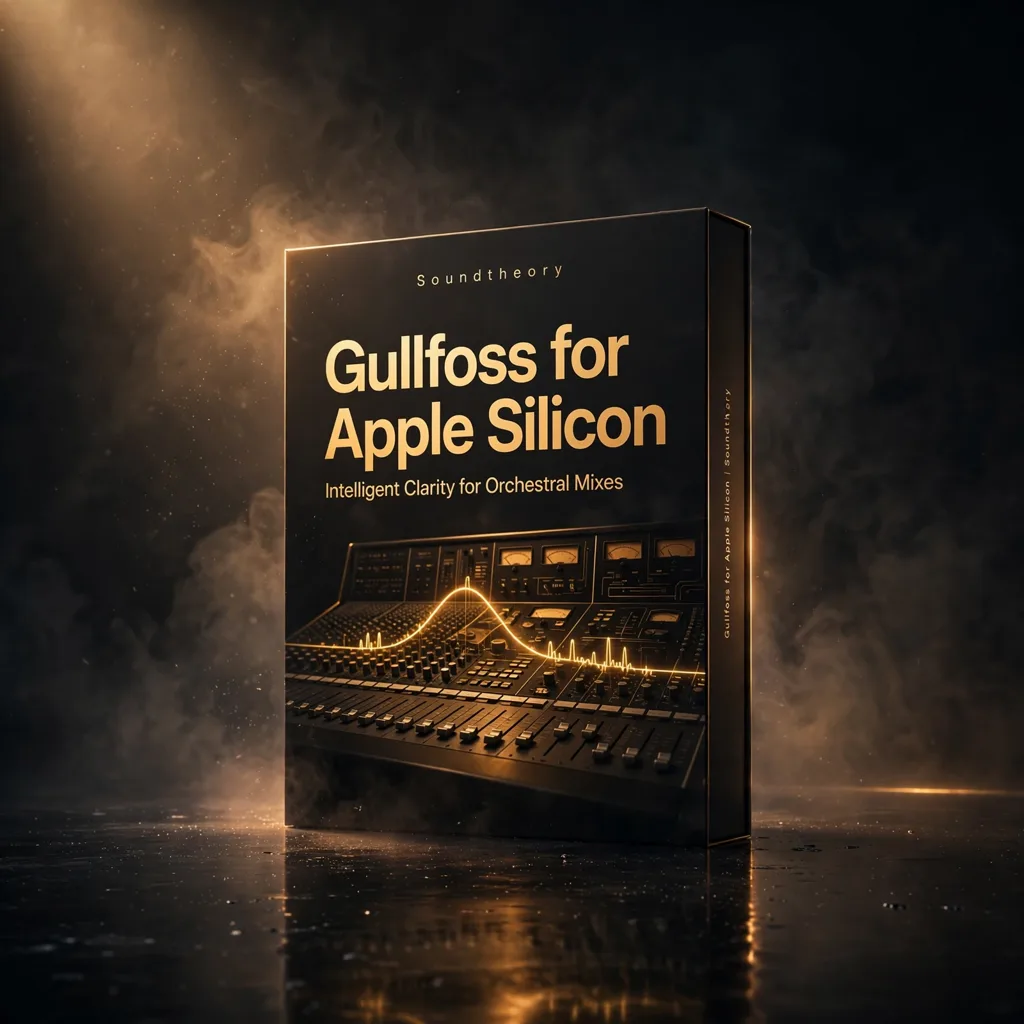


Gullfoss for Apple Silicon – Intelligent Clarity for Orchestral Mixes
€29.99
Soundtheory’s intelligent equaliser does not ask you to hunt for problem frequencies; it models how hearing works and corrects balance in real time. This edition runs natively on Apple Silicon, from M1 through M4 machines named in the source.
A full orchestral mix is a masking problem. Strings cover woodwind detail, brass swallows percussion transients, and a piano that sounded clear alone disappears under the ensemble. Traditional equalisation fixes one instrument at a time, usually by taking something away from another. Soundtheory Gullfoss takes a different approach, described in the source material as computational auditory perception modelling: it analyses how the human auditory system perceives the signal and applies correction aligned with that perception, in real time. This ARM edition is built natively for Apple Silicon, which the source lists as M1, M2, M3 and M4 Macs, running efficiently while performing that continuous analysis.
Recover, Tame and Bias
Three controls define the experience. Recover brings out masked details and restores micro-dynamic information in dense or over-compressed material, which in scoring terms can mean the inner viola line or the articulation inside a string tremolo that the mix had quietly buried. Tame works in the opposite direction, reducing harsh or dominant frequencies that mask other elements, useful when brass or high strings begin to dictate the whole balance. Bias adjusts the preference of the algorithm toward brighter or darker correction, letting the engineer steer the overall tilt without redrawing an EQ curve across the spectrum.
Further controls set the frequency range and the sharpness, or bandwidth, of the processing, so Gullfoss can be aimed at a region rather than applied blindly to everything. The source stresses the speed of its real-time analysis and correction, with extremely fast response to changing content. That responsiveness is what separates it from a static mastering EQ: a cue that moves from a solo cello to a full tutti presents completely different masking problems within seconds, and a processor that follows the music can address each passage on its own terms rather than averaging them into a compromise that suits neither.
Where It Sits in a Scoring Session
On a master bus, Gullfoss can add the clarity and dimension the source describes for full mixes, but composers may find its most revealing use on buses. A string bus, a percussion bus or a hybrid synth group can each be clarified before they meet, so the final stage is making smaller moves. In mastering a soundtrack album, it provides a final perceptual polish when individual cues were mixed at different times and need a consistent sense of openness. It is also a diagnostic tool: if Recover consistently reveals detail you could not hear, the underlying mix balance deserves a second look rather than more processing.
Restraint is the professional habit here. Because the source notes that significant correction can be perceived as the audio improving rather than being processed, it is easy to keep pushing until the mix becomes fatiguing in a way that only appears on a long listen. Work in short comparisons, bypass often, and check the result at the level the audience will actually hear, especially for broadcast and streaming delivery where dialogue competes with the score. Used with that discipline, Gullfoss becomes less an effect and more a second pair of ears, one that never tires during the last hour of a mix session.
Formats, System and Delivery Facts
The source states AU, VST3 and AAX support, running natively on Apple Silicon with macOS 11.0 and later, and compatibility with Logic Pro, Pro Tools, Ableton Live, GarageBand and other major Mac DAWs. This is the ARM edition; the source does not present it as a Windows product, and no Windows specification is claimed. Instant delivery of licence key and installer is stated. No Kontakt requirement or library content applies. The defining facts are the method and the platform: a proprietary psychoacoustic model, the Recover, Tame and Bias controls, frequency range and sharpness adjustment, continuous real-time correction, and native optimisation for Apple M-series processors in a Mac-only package.
Related products
UnFairchild 670M mkII by UnderTone Audio — The Re-Engineered Vari-Mu, Modelled for Your DAW
This is not another stock Fairchild emulation, because the hardware it models is not a stock Fairchild. UnderTone Audio rebuilt the vari-mu concept with variable time constants, an adjustable DC Threshold and switchable detection — and the plug-in adds THD, mix and makeup controls the hardware never had.




Reviews
There are no reviews yet.