
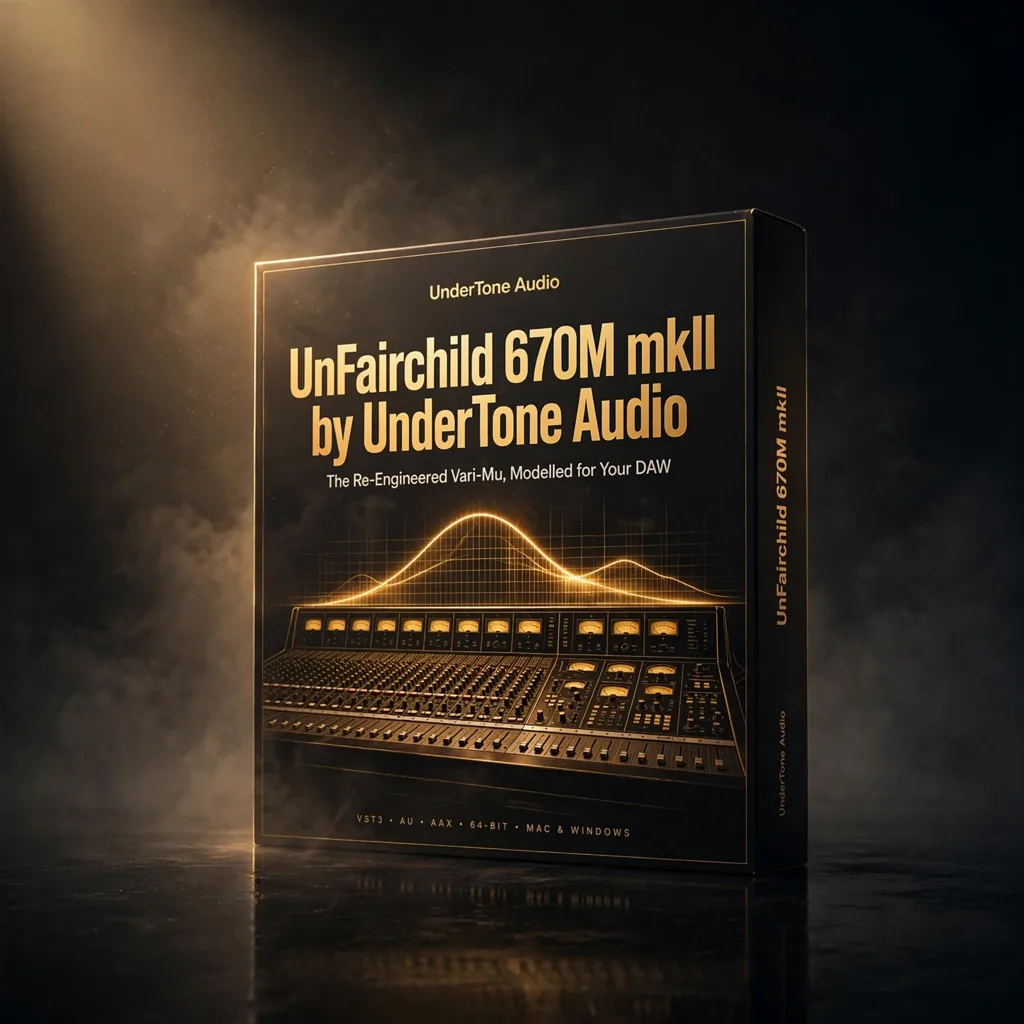

UnFairchild 670M mkII by UnderTone Audio — The Re-Engineered Vari-Mu, Modelled for Your DAW
Original price was: €149.00.€59.99Current price is: €59.99.
This is not another stock Fairchild emulation, because the hardware it models is not a stock Fairchild. UnderTone Audio rebuilt the vari-mu concept with variable time constants, an adjustable DC Threshold and switchable detection — and the plug-in adds THD, mix and makeup controls the hardware never had.
The Fairchild 670 may be the most mythologised compressor ever built, and one of the least convenient: six preset time constants, a fixed detection topology and threshold behaviour designed around 1950s console levels. Engineers tolerate those limits for the sound. UnderTone Audio, run by Eric Valentine, decided to fix them instead, building the UnFairchild 670M II hardware around the original variable-mu tube circuit but with a rebuilt control set. The UTA-D plug-in, developed in partnership with MixLand, models that re-engineered hardware — so it should not be expected to behave like other 670 emulations, because the machine behind it does not.
Ten Time Constants and Two Detection Personalities
Alongside the six preset time constants inherited from the classic design, the plug-in offers four continuously variable time constants with adjustable attack and release, opening a range that runs from the most delicate touch through to genuinely aggressive gain reduction. The DC Threshold is user-adjustable, letting the unit interface properly with modern as well as vintage level structures, and its interaction with the main threshold reshapes the knee in ways a single-threshold design cannot reach. Detection can be switched between feed-back, the classic topology that reacts gently and musically, and feed-forward, which answers faster and more precisely — two distinct compression personalities from one processor. Mid/side operation, sidechain processing, fine left/right balance adjustment and true bypass complete the hardware-derived control set; on a score mix bus, the mid/side settings are particularly valued for widening the image while tightening low-frequency focus.
Three Controls the Hardware Never Had
Software adds a trio of extras. The THD control adjusts UnFairchild-style harmonic character independently of gain reduction, breaking the usual tube-compressor link in which more colour demands more compression — take heavy gain reduction with the character pulled back, or barely compress while pushing the colour forward. A wet/dry Mix control enables parallel compression without extra routing, and post-compression makeup gain provides quick level compensation after a setting is chosen. For a composer printing a two-track master or gluing orchestral stems, that combination makes the plug-in as much a colour instrument as a dynamics one.
Requirements and Trial
System demands are notably modest: a 1 GHz Intel Dual Core or AMD equivalent processor and 4 GB of RAM. macOS from OS X 10.7 upward is supported, with 10.14 or higher recommended, along with Windows 7 and above, a 1024 by 768 or higher display and a 64-bit DAW. Formats are VST3, AU and AAX on Mac, with native Apple Silicon support, and VST3 and AAX on Windows. A support manual is supplied as a PDF, point releases within the version line have been issued since launch, and UnderTone Audio has offered a 14-day trial so the processor can be judged on real sessions rather than on reputation.
Placement is where this processor earns its keep in score work. On the two-bus, gentle settings with a slower time constant can add the density associated with classic vari-mu designs while the mid/side mode keeps low orchestral energy centred and lets the sides breathe. On a drum bus or a percussion stem, the variable time constants and feed-forward detection allow a faster, more assertive grip that the original hardware simply could not offer. The THD control changes the decision-making: colour can be auditioned independently before any gain reduction is committed, which is a far calmer way to work than driving a tube stage and accepting whatever compression arrives with it. Fine left and right balance adjustment, carried over from the hardware, helps when a stereo stem arrives slightly lopsided. Judged against stock 670 emulations it will sound different — deliberately so — and the trial exists precisely so that difference can be evaluated on your own material.
Related products


Legend Channel by PAA Audio — One British-Style Strip for Vocal, Strings and Rhythm Tracks
Legend Channel puts an entire British console channel into one window: a transformer-driven mic and line preamp, filters, a four-band EQ, a compressor and a gate/expander. For a composer mixing their own cues, that is the whole track chain — colour, shape and control — without stacking five plug-ins.



Reviews
There are no reviews yet.