
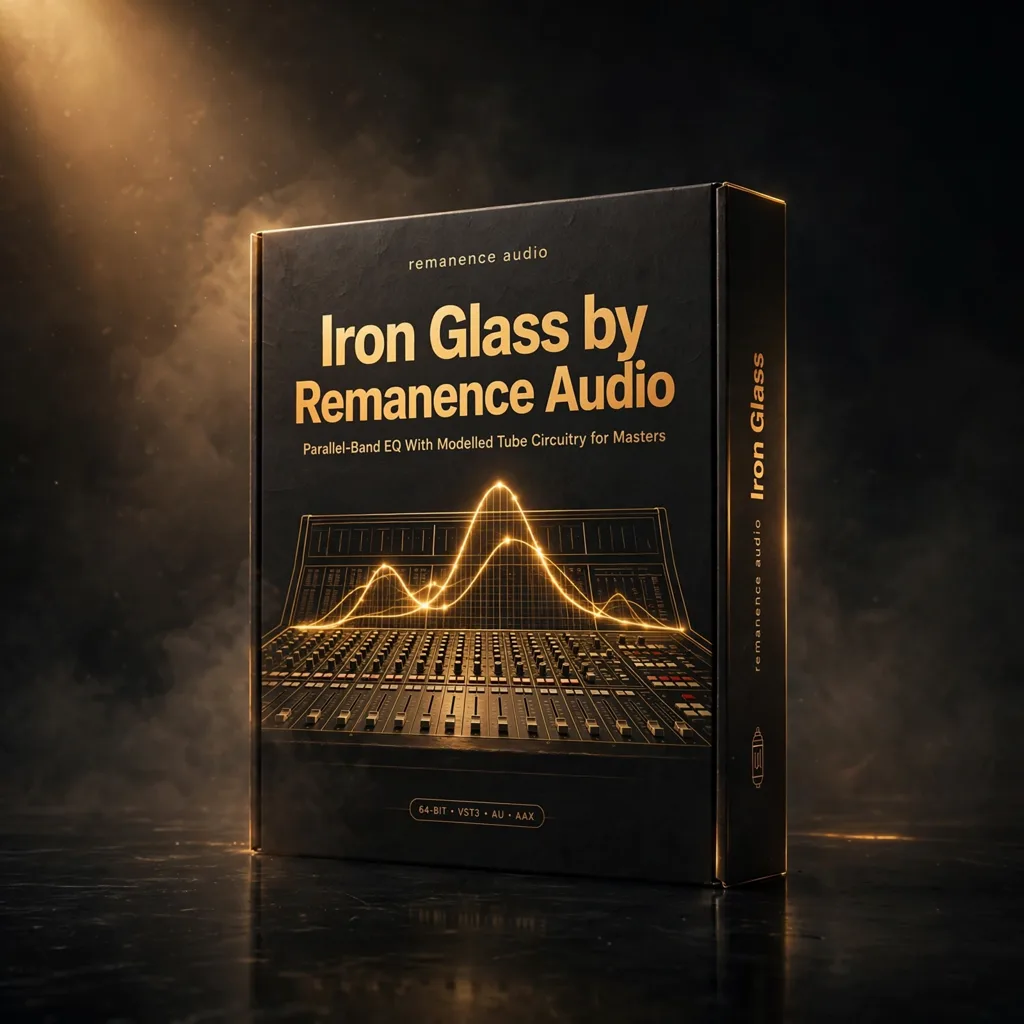

Iron Glass by Remanence Audio — Parallel-Band EQ With Modelled Tube Circuitry for Masters
Original price was: €81.82.€39.99Current price is: €39.99.
Iron Glass takes a scoring-stage view of the master bus: broad, musical moves that hold a cue together rather than carve it apart. Its five parallel bands run through modelled tube, transformer and inductor stages, so the colour and the correction arrive together.
Every composer who has sent a cue out for mastering knows the moment: the orchestral balance is right, the electronics sit where they should, and yet the whole thing needs a gentle tilt — more weight underneath, a little more air on top — without disturbing what the mix already does well. Iron Glass, from Remanence Audio, is built for exactly that kind of work. It is a circuit-modelled equaliser for mixing and mastering in which frequency shaping and analogue-style character are not separate processes bolted together, but two sides of the same modelled circuit.
Five Bands, Working in Parallel
Most equalisers run their bands in series, each stage feeding the next. Iron Glass instead runs five bands in parallel over the same signal and blends the results back together, an approach rooted in classic passive-style equalisation. For broad tonal work — the kind a film score master or a trailer mix usually needs — that architecture favours wide, interacting moves over narrow surgical cuts. Around the bands sit modelled high-pass and low-pass filters drawn from real inductor-based circuitry, useful for clearing sub-frequency clutter under a large ensemble or taming an over-bright top end before the main shaping begins.
The circuit itself is the story. Tubes, transformers and an inductor network are modelled as actual stages, not imitated with a generic saturation plug-in stage placed before or after a digital EQ. Dedicated controls change the characteristics of the tube and transformer stages themselves, so you are altering how the circuit responds rather than simply driving it harder. The developer’s name even points to the idea behind it: remanence, the magnetic memory a transformer keeps after saturation, which shapes how the processor feels following transients.
Using It on Scores, Buses and Stems
On a score master, restraint is the working method. Small low-end adjustments for warmth under strings and brass, a subtle presence move so dialogue-adjacent cues stay intelligible, a touch of high-frequency openness — the modelled stages add density and cohesion while you shape. On a mix bus the same approach glues stems together, and on individual sources, from piano and strings to synths and drums, you can push the circuit harder when deliberate colour is the goal rather than transparency. Input and output gain, each with a generous range, let you decide how strongly the circuitry is driven and then restore a sensible final level, which makes experimenting with the relationship between EQ move and circuit response straightforward.
Specifications and Licensing
Iron Glass provides five parallel EQ bands, modelled tube and transformer stages with their own character controls, a modelled inductor network, high-pass and low-pass filters, and input and output gain ranging over plus or minus 18 dB. It runs as VST3 and AAX on 64-bit Windows 10 and later, and as VST3, AU and AAX on macOS 11 and later, as a universal binary for Intel and Apple Silicon machines. Licensing is fully offline, which suits locked-down studio rooms, and a fully functional 14-day trial is available so you can judge the circuit behaviour on your own cues before committing.
Beginners sometimes expect a mastering equaliser to announce itself, and Iron Glass rewards the opposite instinct. Because the bands interact through the modelled circuit, a one-decibel move can feel larger than the number suggests, particularly once the tube and transformer controls are engaged. A practical method for score work is to set the band shapes first with the circuit character neutral, listen to the whole cue rather than a looped fragment, and then introduce drive in small steps, checking dialogue-heavy and action passages separately. Trailer and games work may welcome more assertive settings, while a delicate chamber cue may need almost nothing beyond the high-pass filter and a breath of top end. That scalability — transparent housekeeping at one extreme, unmistakable colour at the other — is what makes a single processor useful across a whole season of varied briefs, rather than a one-cue novelty that only suits a single mood, genre or production style.
Related products
Fraction v1.1.2 by Eraform Audio — Recorded Analogue Hardware as a Multisampled Instrument
Fraction chooses recordings over modelling. Built by Eraform Audio with Prototype Audio, it is a multisampled instrument whose character comes from actual hardware sources — with a factory expansion of sounds and presets, a particular reputation for bass-weighted and textural material, and a large install to plan for.


Reviews
There are no reviews yet.