
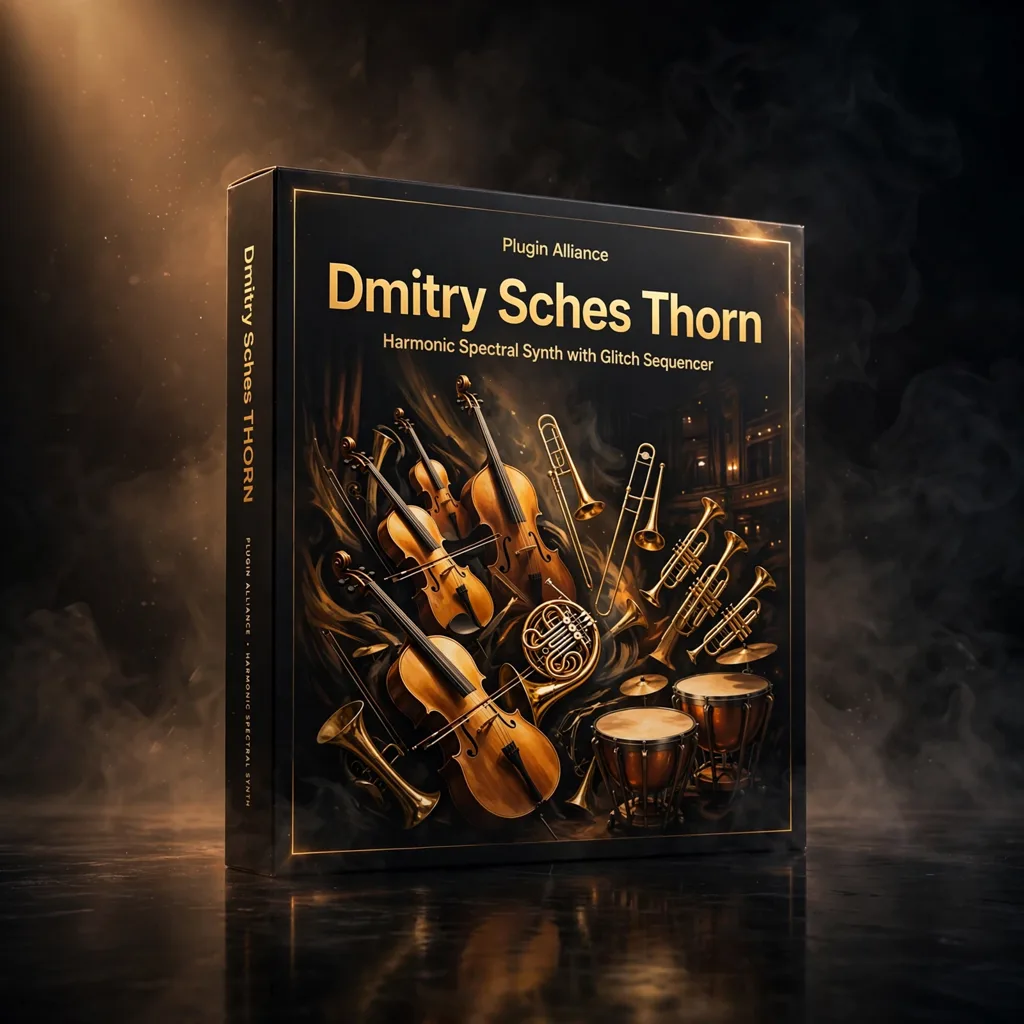

Dmitry Sches Thorn – Harmonic Spectral Synth with Glitch Sequencer
Original price was: €99.00.€49.99Current price is: €49.99.
Dmitry Sches Thorn shapes sound at the harmonic level with three spectral oscillators, 16-frame spectrum tables and harmonic filtering, backed by analog-modelled filters and a grid-based Glitch Sequencer. A modern electronic synth with 600+ presets for basses, leads, plucks and pads.
Most synthesizers shape tone after the fact: generate a bright waveform, then filter it down. Dmitry Sches Thorn works earlier in the chain, at the level of the harmonics themselves. Its three spectral oscillators give direct control over the components that form a sound, using a spectrum-table architecture with 16 frames that can be edited and morphed. For composers and electronic producers, that means timbres can be designed rather than merely filtered — an important distinction when a cue needs a sound that does not already exist in a preset folder.
Spectral Oscillators and Harmonic Filtering
Each spectral oscillator works from a spectrum table of 16 frames, and morphing between frames turns a static tone into a moving one. Spectral effects and harmonic filtering reshape the sound directly at the harmonic level, so brightness, hollowness, aggression or fragility can be addressed in the source material itself. Traditional techniques remain available alongside the spectral engine — FM, RM, PWM and Hard Sync — which widens the palette from precise, glassy digital tones to harder, more physical electronic sounds.
The synthesis is completed by two analog-modeled multimode filters, which bring a familiar, musical shaping stage to the spectral source material. Modulation is generous: three ADSR envelopes, three LFOs and two multi-stage envelopes provide both simple and complex movement, so a pad can evolve slowly under a scene while a pluck snaps with exactly the contour the arrangement requires. Nine high-quality effects finish the chain inside the instrument, keeping designed sounds self-contained and recallable.
Arpeggiator and the Glitch Sequencer
Thorn’s rhythmic tools are part of its identity. A flexible 16-step arpeggiator with MIDI output handles sequences, and because it can send MIDI onward, patterns developed inside Thorn can drive other instruments in a template — useful when a rhythmic figure should lock several layers of a cue together. The dedicated grid-based Glitch Sequencer is the more distinctive tool, creating stutters, chops and modern rhythmic transformations that turn a sustained sound into a pattern with genuine editorial energy.
For media work, those tools map naturally onto trailers, game menus, electronic source cues and transition design, where a sound must feel both musical and mechanical. A bass can be chopped into the picture’s rhythm; a pad can stutter into a title reveal. Because the glitch behaviour is sequenced rather than random, it repeats exactly — essential when a cue must hit the same frame on every pass.
A Library of 600+ Presets
According to Plugin Alliance, Thorn ships with a library of more than 600 presets, covering the basses, leads, plucks, pads, sequences and experimental electronic textures the engine is aimed at. The workflow is streamlined and the architecture relatively CPU-friendly, two qualities that matter in large scoring templates where a synth must earn its place without taxing the session. Starting from a preset and then editing its spectrum tables is also the fastest way to learn the instrument’s logic: change the harmonics, hear the character move.
Scoring Uses and Compatibility
Thorn is designed for modern electronic music production, and its scoring applications follow from that: electronic and hybrid cues needing a distinctive lead, low basses with harmonic detail that survives a dense mix, sequenced figures for technology and science-fiction subjects, and experimental textures for sound-design-led scenes. Its harmonic precision is particularly useful under dialogue, where a sound can be thinned at the harmonic level rather than simply turned down.
Thorn is available for Windows and macOS with VST2, VST3, AU and AAX support depending on platform. At €49.99, half the regular €99 price, it adds a genuinely different synthesis method — spectral, frame-based and rhythmically equipped — to a composer’s electronic toolkit, rather than another variation on the subtractive formula most studios already own several times over.





Reviews
There are no reviews yet.