
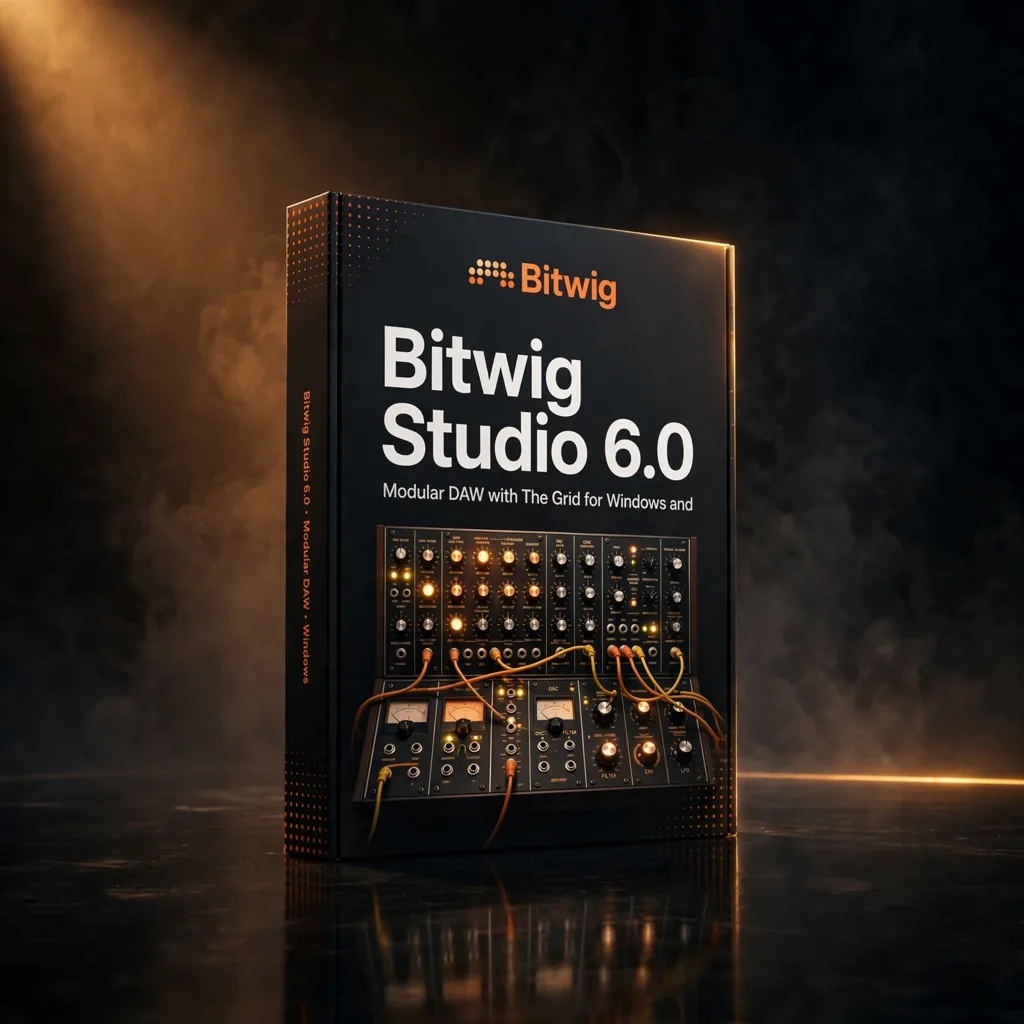

Bitwig Studio 6.0 – Modular DAW with The Grid for Windows and macOS
€29.99
Bitwig Studio 6.0 is a DAW built around modularity, combining a hybrid clip and arrangement workflow with The Grid, its built-in modular synthesis environment. Per-note expression, deep built-in modulation and Note FX are available throughout the session.
Most DAWs inherit their shape from the recording studio: tracks run left to right, ideas are committed early, and experimentation happens inside plugins rather than in the environment itself. Bitwig Studio 6.0 was built with a different instinct. It is a music production DAW for Windows and macOS whose architecture is modular from the ground up, combining a hybrid clip and arrangement workflow with The Grid, a modular synthesis and signal processing environment inside the DAW itself. For electronic producers, live performers and composers who build their own instruments, it offers a session that adapts to the music instead of the other way round.
The Grid: Patching Synths and Effects Inside the DAW
The Grid lets you patch synthesizers, effects chains and generative systems from scratch using visual modular patching, without leaving the session. Poly Grid extends that idea to per-voice modular synthesis, so each voice of a polyphonic instrument can be modulated individually. Because the environment is fully integrated, patches have access to the DAW’s device ecosystem, tempo synchronisation and automation, rather than living in an isolated application that must be persuaded to cooperate. Alongside it, Bitwig’s modulator system allows any parameter to be modulated by LFOs, envelopes, MIDI and audio-rate signals without patching, and Note FX provide a chain of MIDI processing, including arpeggiators, transposers, chord generators and humanizers, that can be applied to any instrument. Multi-output devices support instruments and effects with parallel outputs for complex routing.
Hybrid Workflow and Per-Note Expression
The hybrid workflow combines clip-based performance with linear arrangement editing in one place, so a part can be improvised and looped in clips, then arranged and refined on a timeline without moving projects between environments. That is valuable both on stage, where fluid clip launching suits live performance, and in media work, where a composer may sketch a cue as a set of interchangeable loops before committing to a linear structure against picture. The expressions system allows individual notes inside a MIDI clip to carry their own pressure, slide, pitch bend and timbre, giving MPE-style expressiveness with any instrument rather than only those built for it. For expressive writing, a string line, a synth lead or a hybrid part, that per-note control is the difference between a melody that is merely correct and one that is performed.
A Writing Environment for Modular Thinkers
Composers who work with modular hardware or generative systems will find the logic familiar: build small systems, listen to what they do, and keep the accidents that work. In a scoring context, a generative Grid patch can supply evolving underscore that never repeats exactly, while the clip workflow keeps alternative versions of a cue’s sections available for quick reassembly after a picture change. Sound designers can build a bespoke instrument for a single production and save it as part of the project, rather than renting the idea from a preset. The environment also rewards hybrid setups, since standard plugin formats and MIDI and audio hardware are integrated rather than treated as guests.
Compatibility and Delivery
Bitwig Studio 6.0 runs on Windows 10 or later, with this package covering Windows and macOS, and supports VST3 and AU plugin formats alongside standard MIDI and audio import and export; the source listing also notes AAX among its supported formats. It works with all major hardware controllers and MIDI interfaces, and the licence key and installer are delivered instantly after purchase. If a traditional linear DAW has started to feel like a container you work around rather than an instrument you play, Bitwig Studio 6 is the considered alternative: modular where you want to build, immediate where you want to perform, and expressive at the level of the individual note.
For composers used to delegating the experimental stage to external modular software, that integration removes a layer of friction from the working day: no separate application to synchronise, no audio to route between programs, and no ideas lost because capturing them meant stopping to set up a recording path. The experiment and the production live in the same file, saved together and recalled together.





Reviews
There are no reviews yet.