
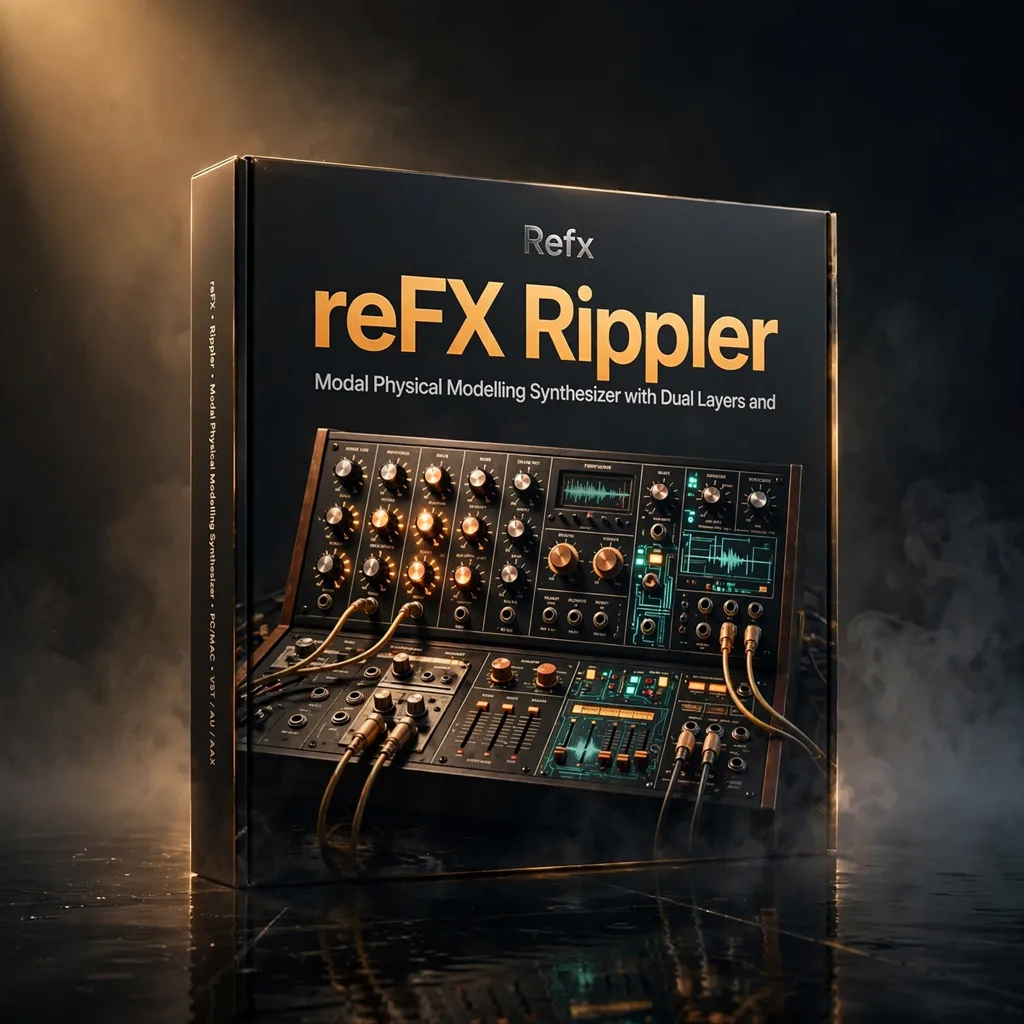

reFX Rippler – Modal Physical Modelling Synthesizer with Dual Layers and 441 Presets
Original price was: €99.99.€39.99Current price is: €39.99.
Rippler generates sound with no samples at all, using banks of coupled resonators across 12 acoustic models, plus dual layers, two oscillators and filters per layer, deep modulation and 441 presets.
Composers who work with samples spend their days triggering recordings of physical objects. reFX Rippler takes the physics and leaves the recordings behind. It is a dual-layer physical modelling and subtractive synthesizer for Mac and Windows, built on modal synthesis, in which banks of resonators with bi-directional energy coupling generate the sound from nothing. Twelve acoustic models cover String, Beam, Squared, Bell, Membrane, Plate, Drumhead, Djembe, Vibraphone, Marimba, Open Tube and Closed Tube, with a Manual mode for painting your own additive resonators. For scoring, that means struck, plucked and resonant tones that behave like instruments but can be pushed into territory no real instrument occupies.
Resonators, Exciters and Layers
Sound begins with an exciter, and Rippler’s exciter section supplies 32 samples, custom impulses, sample import and live sidechain input, so a resonator bank can be driven by material from your own session, including audio from elsewhere in the cue. Each of the two layers then adds two oscillators with Phase, Fold and Asymmetry controls, and two filters chosen from 27 types including vintage, ladder and vowel designs. Layers can be combined with parallel and serial resonator routing, so one layer can provide the attack while another supplies the resonant tail, and the bi-directional energy transfer between resonators gives the result an evolving timbral behaviour that static sampling cannot reproduce.
That architecture is particularly useful for hybrid cues. A marimba or vibraphone model can be layered with a subtractive oscillator to make a mallet sound that still feels electronic, or a membrane model can be driven hard to create resonant percussion that matches a trailer’s sound design rather than its orchestra. Because nothing is a fixed recording, tuning, decay and response can follow the harmony and tempo of the scene.
Modulation, Effects and Performance
Modulation comes from four LFOs with 64 shapes, four envelopes, random generators, MIDI and MPE sources, and macros with custom response curves, with Mod Mapping to shape how a modulation connection behaves. The effects system offers 13 effects across three chains, including the five-mode RutaVerb and the lighter MiniVerb, and effect order can be rearranged so the chain becomes part of the sound design. A full arpeggiator and sequencer are included for rhythmic material, which pairs naturally with the percussive models.
Rippler supports MPE and aftertouch, so a resonant tone can be bent and pressured per note rather than only per channel, an important detail when a modelled string or tube is carrying a melody. Scala and MTS micro-tuning support extends that expressiveness to non-standard tunings, useful for historical, regional or deliberately unsettled scoring. The factory library contains 441 presets, which is the fastest way to learn what the models can do before building your own.
Formats and Installation Facts
Rippler is available in VST3, AU and AAX formats for Mac and Windows, with an install of roughly 51.3 MB, a remarkably small footprint for an instrument of this depth because the sound is generated rather than stored. No sample library download is involved. For a composer whose template is heavy with gigabytes of orchestral content, Rippler offers the opposite proposition: a compact, deeply programmable source of acoustic-feeling, electronic-leaning tones that can supply percussion, mallets, bells, resonant pads and experimental leads from a single plugin, and respond to performance in a way a sample cannot.
There is also a practical advantage for composers who collaborate or move between rooms. A preset built from resonators, oscillators, filters and modulation travels as a small set of parameters rather than as a folder of audio, so a sound designed on a laptop arrives intact on a studio machine. The arpeggiator and sequencer make the percussive and mallet models immediately useful for rhythmic underscore, while MPE and aftertouch let a lead or a modelled tube respond to the kind of phrasing a keyboard player would normally reserve for an acoustic instrument. That responsiveness is what keeps a modelled sound musical rather than merely clever.
Related products



FREQ-FX by Dezert Audio — Eight Analogue-Modelled Modules for Colour, Width and Movement
FREQ-FX is Dezert Audio's first effects plug-in, from a developer known for sampled instruments built on rare hardware. Its eight analogue-modelled modules target texture, movement, width, depth and distortion — the qualities that separate a cue that is technically correct from one that feels alive.

Reviews
There are no reviews yet.