
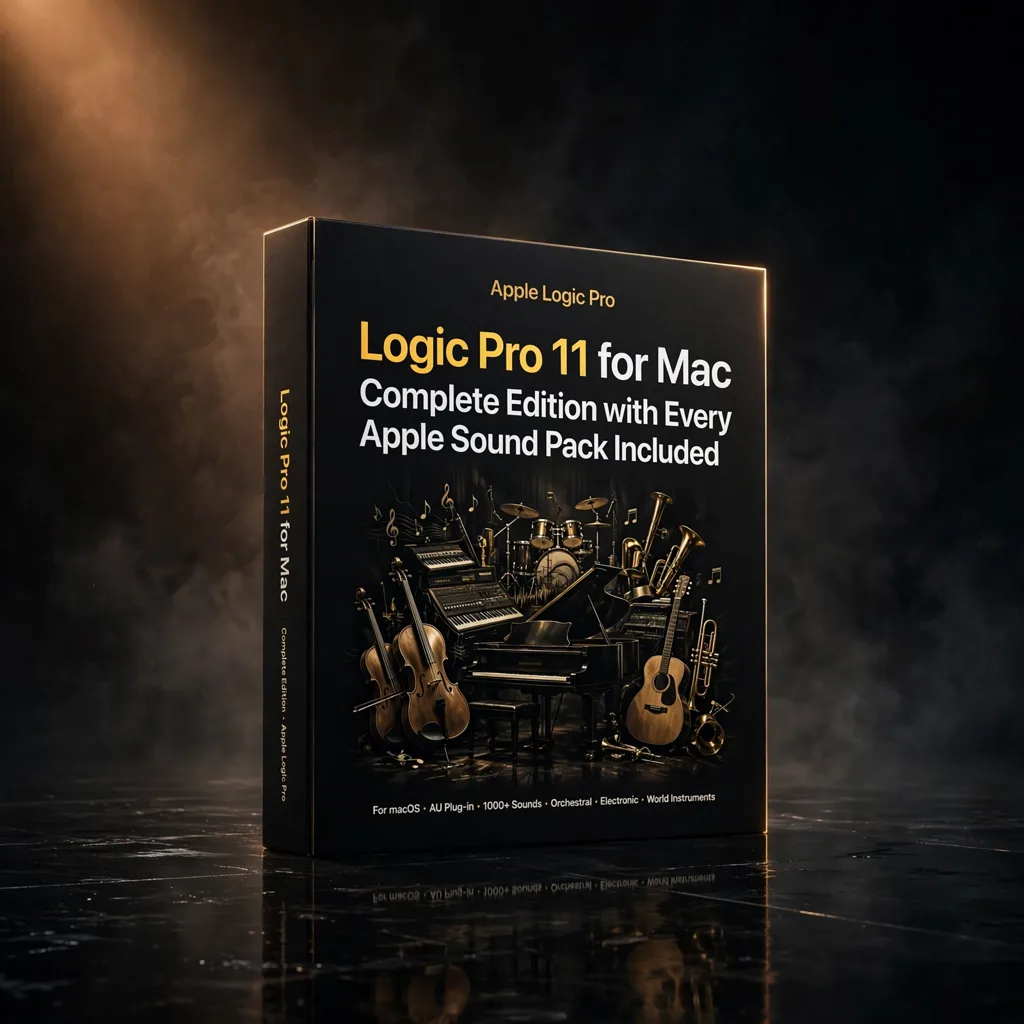

Logic Pro 11 for Mac Complete Edition with Every Apple Sound Pack Included
€29.99
Apple’s flagship Mac DAW in its Logic Pro 11 form, with AI Session Players, Stem Splitter, ChromaGlow and Flashback Capture. The complete Apple Sound Library is included too, with over 70GB of instruments, loops and samples.
A Scoring Stage Inside a Mac
For composers working on Mac, Logic Pro has long been the room where sketches become finished cues, and Logic Pro 11 pushes that role further with a set of AI-assisted tools and the complete Apple Sound Packs collection included. The headline figure is scale: over 70GB of instruments, loops and samples in the sound library, spanning orchestral packs, electronic essentials, world instruments and cinematic textures. Instead of assembling a toolkit piece by piece, you open a session and the raw material for film scoring, song production and live performance is already installed and waiting.
What makes this edition notable is how the new tools change the writing process itself. Session Players generate human-like performances from an AI Drummer, Bassist and Pianist, Stem Splitter separates vocals, drums and instruments from full tracks in one click, and ChromaGlow adds warm, analogue-style saturation modelled on iconic hardware. Flashback Capture quietly protects the idea you played before you remembered to press record. For a composer under deadline, those are not novelties; they are hours returned to the schedule and performances you can react to, arrange around and orchestrate against from the first morning of a project.
Players, Splitting and Saturation
Session Players deserve attention from anyone who writes alone. A drummer who follows your arrangement, a bassist who locks to the harmony and a pianist who voices chords plausibly give a solitary composer something to push against, much like a small ensemble reading a sketch in the room. Stem Splitter works in the opposite direction, pulling existing audio apart so vocals, drums and instruments can be studied, replaced or re-scored — invaluable for trailer reworkings, remixes and dialogue-adjacent music edits. ChromaGlow then adds the harmonic warmth that keeps an all-digital production from sounding sterile at the mix stage.
The included library is organised for real work. Orchestral packs cover strings, brass, woodwinds and choirs; electronic packs bring EDM drums, synth essentials and techno and house loops; world and ethnic content spans African, Asian and Middle Eastern instruments; cinematic and ambient packs supply atmospheric textures for film work; hip-hop and trap packs add 808 kits, modern drum machines and vocal chops; and band instruments cover guitars, bass, keys, drums and percussion. With every Apple Live Pack and expansion pack pre-installed, according to the source listing, you start producing rather than hunting for sounds across the internet.
Writing, Arranging and Finishing Cues
In a scoring workflow, Logic 11 supports the whole arc. Sketch with Session Players, replace parts with the orchestral packs as the cue firms up, use alternative scales and temperaments from the tuning system exploration when a brief calls for something less conventional, and print stems from the same session. Flashback Capture suits the way composers actually improvise at the keyboard — the best take is often the unguarded one. For songwriters and live performers the same environment holds loops, band instruments and electronic packs in one place, so a production can move from demo to stage arrangement without changing rooms.
Treat the AI tools as collaborators with good instincts rather than replacements for judgement. Let a Session Player propose a groove, then edit its phrasing the way you would direct a musician in the room. Use Stem Splitter to learn how a reference mix is balanced before you write your own version. Apply ChromaGlow in small amounts across buses to glue a hybrid orchestral-electronic score together. The depth is there for experienced users, yet a newcomer can open the library, choose a pack that matches the brief, and have a credible arrangement started within a single session.
System Requirements and Format Facts
The source specifications list macOS 12 or later on Intel and Apple Silicon machines, in AU and VST3 formats, with 8GB of RAM as a minimum and 16GB recommended. Storage is the figure to plan for: 80GB of free space is listed for the full library installation, reflecting that complete sound library of over 70GB. The CPU guidance mentions Intel i5 or Apple M1, M2 and M3 optimisation. Check your current macOS version before installing, and allow time for the full library download if you intend to install every pack from day one.
Related products

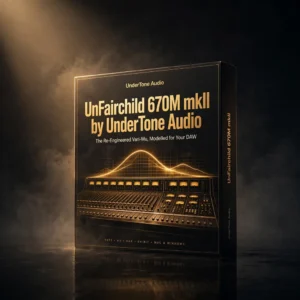
UnFairchild 670M mkII by UnderTone Audio — The Re-Engineered Vari-Mu, Modelled for Your DAW
This is not another stock Fairchild emulation, because the hardware it models is not a stock Fairchild. UnderTone Audio rebuilt the vari-mu concept with variable time constants, an adjustable DC Threshold and switchable detection — and the plug-in adds THD, mix and makeup controls the hardware never had.


Reviews
There are no reviews yet.