
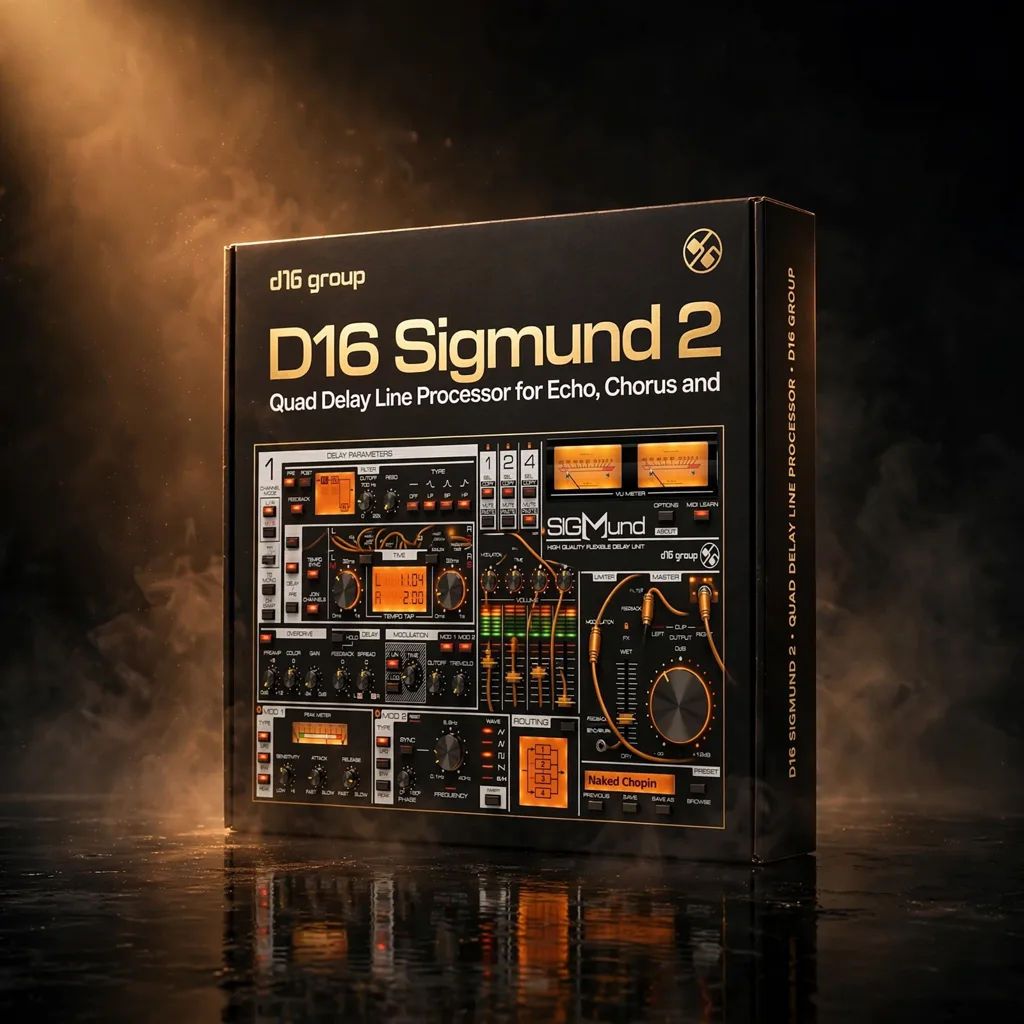

D16 Sigmund 2 – Quad Delay Line Processor for Echo, Chorus and Spatial Design
Original price was: €99.00.€39.99Current price is: €39.99.
D16 Sigmund 2 routes four independent delay lines through nine topologies, each with filtering, overdrive and modulation, reaching from clean echoes down to 0.1 ms chorus and flanging territory. One processor for delay, space and experimental cue design.
A conventional delay answers one question: how long until the echo returns? D16 Sigmund 2 asks a more interesting one — what happens when four complete delay processors, each with its own filtering, overdrive and modulation, can be interconnected in nine different routings? The answer is a single plugin that works as a rhythmic delay, chorus, flanger, tremolo, spatial processor and experimental sound-design environment. For composers, that breadth means one familiar tool can handle everything from a subtle echo on a solo line to the warped, evolving textures of a science-fiction cue.
Four Lines, Nine Topologies
Each of Sigmund 2’s four delay lines is an independent processor. One line can provide a short stereo slap, another a longer rhythmic echo, a third filtered feedback and a fourth modulation or spatial treatment, and the internal delay-line mixer balances their contributions into a single result. The nine routing topologies determine how the lines connect: parallel configurations layer echoes and build stereo texture, while serial configurations cascade signal through multiple stages so repeats grow progressively more complex.
The delay algorithm itself spans an unusually wide range, operating down to approximately one-tenth of a millisecond. At long settings it behaves as a conventional echo; at those extremely short times it becomes a modulation tool, which is what allows Sigmund 2 to move naturally into chorus and flanging without a second plugin. Current version is 2.0.1.
Modulators That Follow the Performance
Four multi-purpose modulators drive the movement, each able to operate as an LFO, an Envelope or a Peak Follower, and each independently retriggerable by MIDI notes or incoming transients. LFO modulation supplies continuous cyclical movement over delay time, filter cutoff or line volume. Envelope modulation responds to rhythmic, transient-rich material, while the Peak Follower follows amplitude — an expressive route to auto-wah-style filter movement that answers the performance itself.
Modulating delay time at short settings yields chorus and flanging; at longer settings it produces pitch-like movement and warped echoes. Modulating line volume ranges from gentle animation to tremolo and rhythmic gating, and because lines move independently, the combined texture can be genuinely intricate.
Filtering, Overdrive and Stereo Space
Every delay line includes a multimode filter that can sit inside or outside the feedback loop. Outside, it behaves as tonal control, trimming the delayed signal so it rests behind a dry source. Inside the loop, each repeat progressively changes in tone — echoes darken as they decay — and with cutoff modulation the same architecture produces wah-style sweeps, vowel-like movement and phaser-style textures. Built-in overdrive per line adds harmonic colour and more aggressive feedback behaviour, and different paths can be driven differently.
Stereo processing supports Left/Right and Mid/Side operation with phase relationships between channels open to manipulation, so Sigmund 2 also serves as a widening and spatialising tool for orchestral stems, pads and ambience. Parameter locking protects chosen settings while browsing presets — particularly valuable on a send, where a wet/dry relationship should survive auditioning — and the library of more than 400 factory presets provides both instant results and a practical education in how the architecture fits together.
Formats and Scoring Uses
Sigmund 2 supports Windows 7 or newer with a 64-bit host, and macOS 10.13 through macOS 26 on Intel and native Apple Silicon, in VST2, VST3, AU and AAX formats depending on platform, at sample rates of 44.1 kHz or higher; a host application is required, as there is no standalone version. In scoring, reach for it on solo instruments needing depth without reverb wash, on vocals and dialogue-adjacent elements for throws and filtered echoes, and on electronic material for glitch, feedback networks and evolving soundscapes. At €39.99, 60% below the regular €99 price, it replaces a shelf of single-purpose modulation plugins with one deep, recallable environment.





Reviews
There are no reviews yet.