
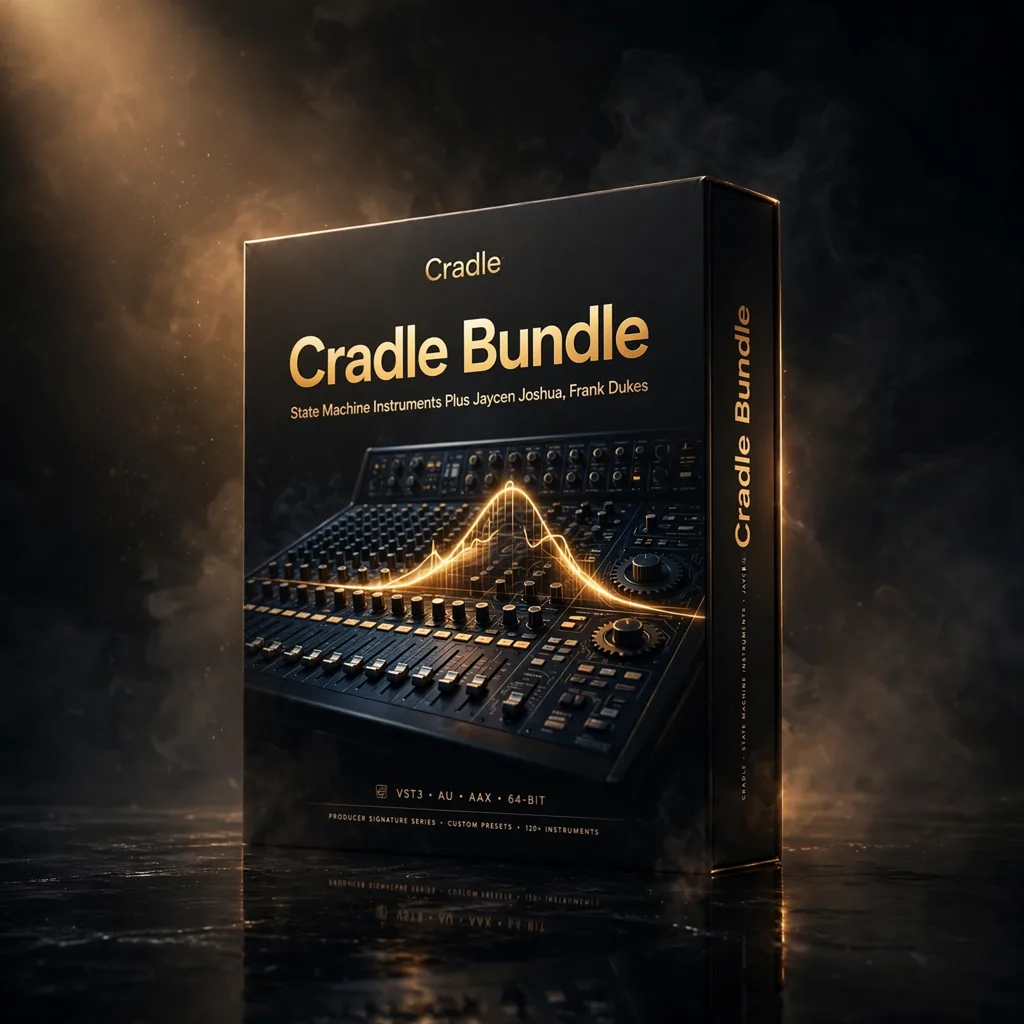

Cradle Bundle – State Machine Instruments Plus Jaycen Joshua, Frank Dukes and Louis Bell Tools
€39.99
Instruments and signature processors from one developer: faded keys, low end, slow-drifting ambience and hybrid strings alongside mix and vocal tools co-designed with Grammy-winning engineers and producers. A compact bundle with a strong identity of its own.
The cradle bundle is built from two families of products. The first is State Machine, a series of instruments with deliberately evocative names. Faded Keys is a large keys collection blending acoustic, analog and digital sources into 190 mix-ready presets spanning four decades, from classic Rhodes warmth to modern synth keys. For a composer, that range covers both period scoring, where the keyboard has to sound like it belongs to a specific era, and contemporary underscore, where a slightly worn electric piano under dialogue does more than a pristine grand.
Four State Machine Instruments
Low End is a bass instrument built for deep, tight, punchy foundations. Slow Drift creates lush ambient textures and evolving atmospheres, aimed in the source material at cinematic scoring, chillwave, downtempo and experimental work; in practice it is the instrument you reach for in the long, quiet stretches of a scene where the harmony barely moves but the texture must never sit still. Weird Strings is a hybrid acoustic and synth string instrument, blending string tones with modern synth layers for textures that read as orchestral in shape but not in origin, which is useful when a score needs strings that feel unfamiliar.
Signature Mix, Synth and Vocal Tools
The second family is a set of artist-led processors. The God Particle was co-designed with Grammy-winning mixer Jaycen Joshua and is described as dialling in depth, clarity and loudness, with an intelligent limiter for punchy, competitive masters. Orion is its drum companion, adding punch, weight and saturation with smart routing. The Prince is Frank Dukes’ signature synth and effects plugin, offering dreamy pads, lush leads and modern textures. The Spirit is Louis Bell’s signature vocal chain in a single plugin, aimed at polished, radio-ready vocals in seconds.
For media composers these four are about translation. A main title song, a source cue, a featured vocal moment or a trailer rework of a theme all have to sound like records, not like demos, and they have to do it quickly. A vocal chain and a mix finisher designed by the people who make those records compress a long chain of decisions into a small number of controls, leaving the composer free to think about the cue rather than the processing.
In a Scoring Workflow
A plausible session: Slow Drift and Weird Strings lay down an atmosphere, Faded Keys carries the harmonic movement, Low End anchors it, and The God Particle finishes the stereo mix so the cue can be sent to a director sounding close to final. Because the instruments share a design language, moving between them is fast, and the source emphasises intuitive interfaces and instant results across the range. It is also a bundle that crosses into song work without apology, which suits composers who write source music as well as score.
Requirements and Trials
The source lists macOS Mojave 10.14 or later and Windows 10 64-bit version 2004 or later, an Intel i5 or better with AVX2, Apple Silicon M1 or later, or AMD Ryzen Pro 3 or later, a minimum of 8GB RAM, and around 2GB total during installation at roughly 600MB per plugin installed. Formats are AU and VST3, tested in Logic Pro 10, FL Studio 20, Ableton Live 11, Cubase 11 and Pro Tools 2021 and later. Free 14-day trials are offered for each plugin according to the source material.
Eight products, two clear purposes: instruments that generate atmosphere and character, and processors that finish a mix to a commercial standard. That pairing is what gives this bundle its coherence.
What lingers after working through the list is how deliberately the bundle avoids the generic. Keys are faded rather than pristine, strings are weird rather than simply lush, drift is slow rather than static, and the processors carry the names and working habits of specific people rather than anonymous design teams. For composers, that specificity is useful because scores are judged on identity. A cue built from these instruments tends to sound like a particular piece of music for a particular story, instead of an assembly of defaults. If your work leans toward songs, atmospheres and distinctive textures rather than orchestral simulation, this collection is pitched exactly at that territory.




Reviews
There are no reviews yet.