
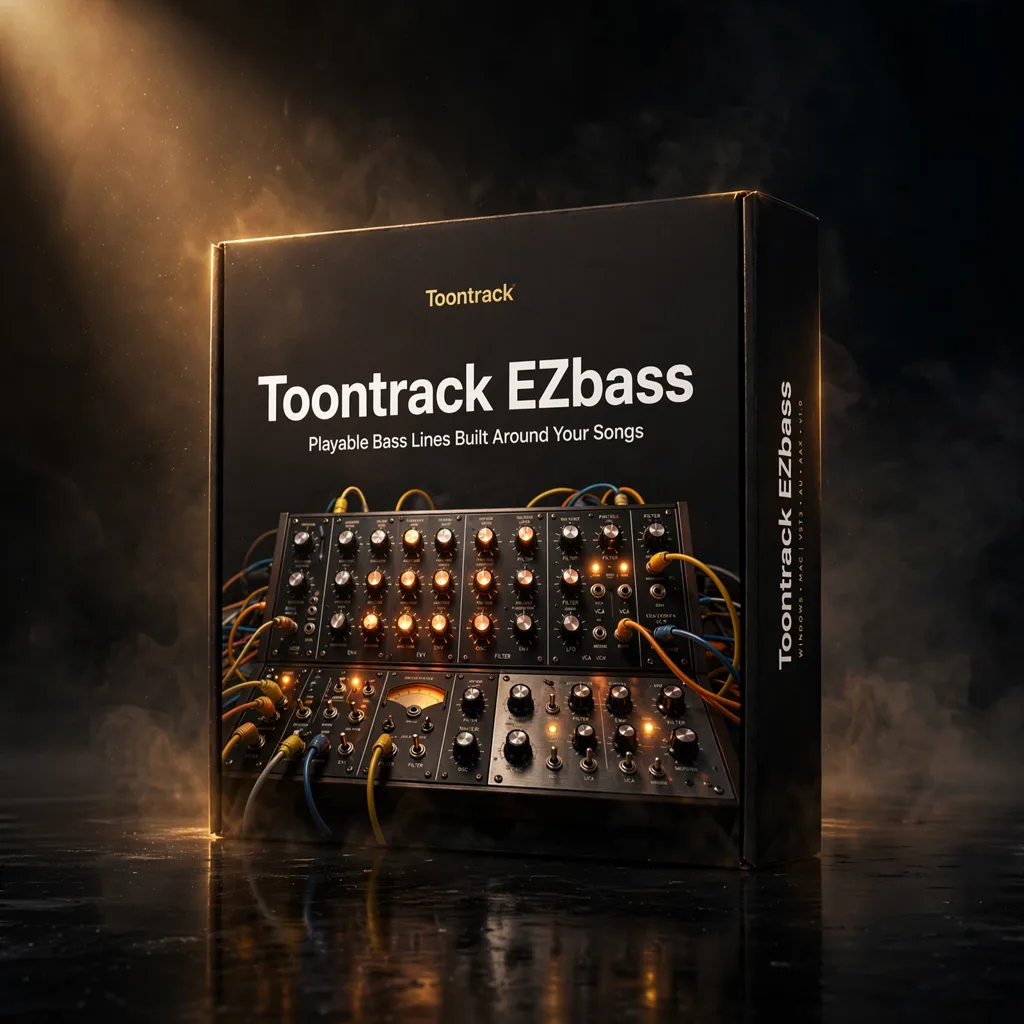

Toontrack EZbass – Playable Bass Lines Built Around Your Songs
€29.99
Toontrack EZbass is a virtual bass instrument designed around songwriting, with Modern and Vintage bass libraries, audio-to-MIDI conversion and a Grid Editor for dynamics and articulations. Tap2Find helps you locate the rhythm a track is asking for.
Bass lines are easy to programme badly: correct notes, wrong feel, no relationship to the kick, no sense of a player deciding where to breathe. EZbass approaches the instrument from the songwriter’s side, in the tradition of Toontrack’s EZ line, by combining sampled Modern and Vintage bass libraries with tools that generate and edit lines in context. For composers, that matters in the many cues where bass is not a headline instrument but the thing quietly holding the harmony and the groove together, a singer-songwriter cue, a contemporary drama underscore, a production-music track that has to sound like a band by Friday.
Two Basses, Chosen by Character
You choose between Modern and Vintage instrument libraries according to the character the track needs, brighter and more contemporary, or warmer and more period. The audio-to-MIDI feature converts monophonic audio into MIDI, so a line you sang, played on guitar or sketched on another instrument can become the starting point for the bass part. Tap2Find works from rhythm: tap or play the feel you want and EZbass helps match it to suitable material. Editing happens in the Grid Editor, where dynamics and articulations can be fine-tuned so slides, accents and note lengths behave like a performance. A range of presets and automation support round out a workflow designed to minimise setup and maximise the time spent actually hearing the line against your track.
Lines Written Around Your Track
Used in a score, EZbass is at its best generating the honest first version of a line: the part a good session player might offer on the first take, which you then simplify, move or accent to fit the picture. Bass in a score is architecture. It tells the audience how solid the ground is, whether a chase is gaining weight or a room is quietly unsafe. Write the line after the harmony is settled, then test it at low volume on small speakers, because felt bass that disappears on a television mix leaves a cue strangely weightless. Keep movement purposeful: long held notes for dread, a repeating figure for pursuit, short separated notes where the picture needs air. Watch the relationship with low strings, kick drum and effects hits, and give each element its own octave and moment. When the bass is right, the rest of the orchestra sounds more confident without playing any louder.
Check the line against the final harmony, not an early sketch. One changed chord can turn a confident bass note into an argument the whole cue has to work around.
Formats and Compatibility
EZbass integrates with major DAWs including Ableton Live, FL Studio and Logic Pro, and is supplied in VST, AU and AAX formats for Windows and macOS, as documented in the source material. The listing describes performance optimised for studio and live use with low CPU demand. Detailed minimum system figures and library size are not specified in the supplied text, so the practical facts to plan around are the formats, the two included libraries and the host compatibility above. As part of the wider Toontrack ecosystem, it is designed to sit naturally alongside the company’s drum and keys instruments in a songwriting template.
The Bass Player in the EZ Family
Choose EZbass if you write at another instrument and need bass parts with a player’s instincts rather than a keyboard player’s habits. It will not replace a great bassist on a feature session, but for demos, cues and productions on a clock, it delivers the line, in character, while the idea is still fresh.
Context is the real test for any production tool, so judge it inside a finished cue rather than in isolation. A sound that supports the picture without drawing attention to itself is often doing the most sophisticated work of all. Keep notes on the settings you return to, because a personal shortlist develops quickly and speeds up every future session. Small contrasts matter in long-form work, and changing one element per scene keeps a musical world coherent but alive.
Related products
StandardCLIP by SIR Audio Tools — The Clipper That Lets You Tune Its Own Oversampling
Most clippers hide the filtering that decides whether clipping sounds like loudness or like distortion. StandardCLIP exposes it: oversampling up to 256x, linear- or minimum-phase filters you can tune yourself, a variable clip shape, and an assistant that measures your loudest passage and sets safe output gain.
UnFairchild 670M mkII by UnderTone Audio — The Re-Engineered Vari-Mu, Modelled for Your DAW
This is not another stock Fairchild emulation, because the hardware it models is not a stock Fairchild. UnderTone Audio rebuilt the vari-mu concept with variable time constants, an adjustable DC Threshold and switchable detection — and the plug-in adds THD, mix and makeup controls the hardware never had.

Legend Channel by PAA Audio — One British-Style Strip for Vocal, Strings and Rhythm Tracks
Legend Channel puts an entire British console channel into one window: a transformer-driven mic and line preamp, filters, a four-band EQ, a compressor and a gate/expander. For a composer mixing their own cues, that is the whole track chain — colour, shape and control — without stacking five plug-ins.




Reviews
There are no reviews yet.