
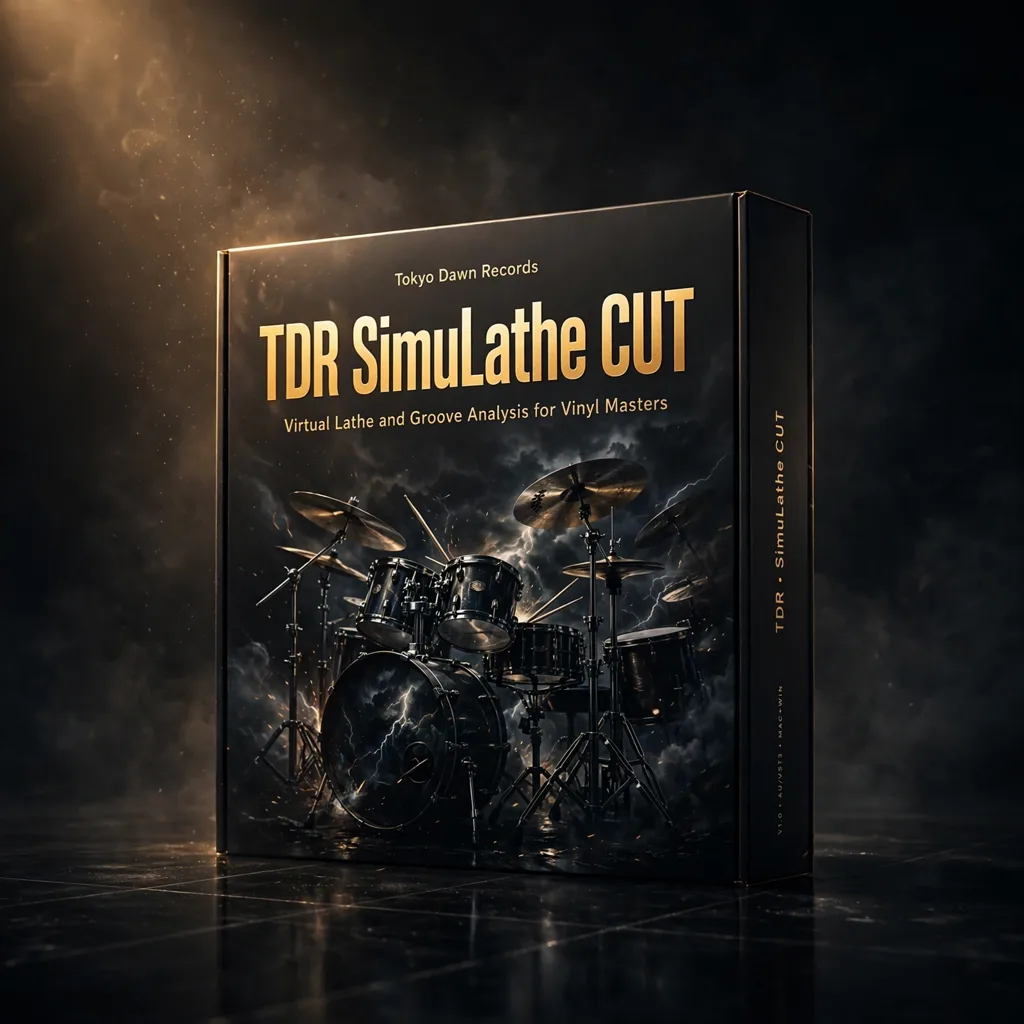


TDR SimuLathe CUT — Virtual Lathe and Groove Analysis for Vinyl Masters
Original price was: €240.00.€59.99Current price is: €59.99.
TDR SimuLathe CUT is a tdr simulathe cut vinyl mastering laboratory: a fully parametric virtual cutting lathe with groove excursion, width and velocity analysis. Heatmaps, a groove microscope and three modelled pickups let engineers test a cut before any lacquer is touched.
Releasing a score on vinyl is a romantic decision with unromantic physics. Low-frequency energy, stereo width and groove velocity that behave perfectly in a digital master can overrun the space on a disc, and the first proof of that is traditionally an expensive cut lacquer. Tokyo Dawn Records TDR SimuLathe CUT exists to move that proof earlier. It is a professional disk mastering and vinyl cutting simulation plugin — described by its developer as a complete virtual disk mastering laboratory — that models the physical process of cutting audio onto vinyl, so mastering engineers and cutting facilities can analyse, correct and share a virtual test cut before real cutting begins.
The Virtual Lathe and Groove Analysis
At its centre is a fully parametric virtual cutting lathe simulating groove geometry, disk rotation, groove width, groove depth, velocity limits and physical disk constraints. Around it sits an extensive monitoring section measuring groove excursion, groove width, groove velocity, stereo width, gain, on-disk space consumption and land — the space between grooves. Heatmap inspection tools let engineers locate problem areas visually across a side, and a distinctive Groove Microscope allows virtual grooves to be inspected directly, with real-time visualisation and physical groove monitoring. This is analysis of a different kind from a spectrum display: the question is not only what the audio contains, but what the audio will become when it is engraved. Specialised processing modules operate on those physical parameters directly, including highpass and lowpass filters, elliptical filters, and limiters for groove width, groove excursion and velocity. For a film score destined for a soundtrack LP — wide dynamics, deep low strings, sudden tutti peaks — that ability to predict where a side will struggle, and to trade space, level and low-end width deliberately, is the entire value of the tool.
Pickup Modelling and the Test-Cut Workflow
Simulation does not end at the cut. SimuLathe CUT includes three physically modelled turntable pickup systems, allowing users to monitor vinyl playback, preview cutting results, evaluate playback quality under simulated real-world listening conditions and generate shareable test cuts. That closes a practical loop for remote work: a composer or label can hear a representation of the vinyl version, comment, and approve changes before manufacturing, rather than discovering the disc’s character at the pressing plant. The workflow supports host sync, host automation sync and a manual playhead mode, alongside multi-side support and multi-disc projects, so a double-LP soundtrack can be planned as a whole — sides balanced against each other, space consumption tracked across the release. The developer’s positioning, noted in the source, is candid: the CUT edition is primarily intended for professional disk mastering services and lathe operators, and users seeking general vinyl referencing may prefer the REF edition. It is also described as designed to match various disk cutting systems and pitch computer configurations with a high level of accuracy.
Formats and Platform Facts
The source for this edition specifies macOS — listing macOS 10.9 and later on Intel and Apple Silicon machines — with VST3 and AU formats, and hosts including FL Studio, Ableton Live, Cubase, Studio One, Reaper, Logic Pro, Nuendo and Pro Tools. Its documented benefits for mastering workflows include predicting vinyl compatibility, improving disk space usage, reducing cutting risks, optimising groove layout, identifying problem frequencies, improving production efficiency and quality control, and generating shareable test cuts. This is not a vinyl-colouration effect and should not be bought as one; it makes no attempt to make digital audio sound old. It is an engineering instrument for people who cut, or commission, real records — and for a score being prepared for a serious vinyl edition, it offers something rare in audio software: the chance to rehearse a physical process, completely, before committing to it.
Related products
StandardCLIP by SIR Audio Tools — The Clipper That Lets You Tune Its Own Oversampling
Most clippers hide the filtering that decides whether clipping sounds like loudness or like distortion. StandardCLIP exposes it: oversampling up to 256x, linear- or minimum-phase filters you can tune yourself, a variable clip shape, and an assistant that measures your loudest passage and sets safe output gain.

Legend Channel by PAA Audio — One British-Style Strip for Vocal, Strings and Rhythm Tracks
Legend Channel puts an entire British console channel into one window: a transformer-driven mic and line preamp, filters, a four-band EQ, a compressor and a gate/expander. For a composer mixing their own cues, that is the whole track chain — colour, shape and control — without stacking five plug-ins.


Reviews
There are no reviews yet.