
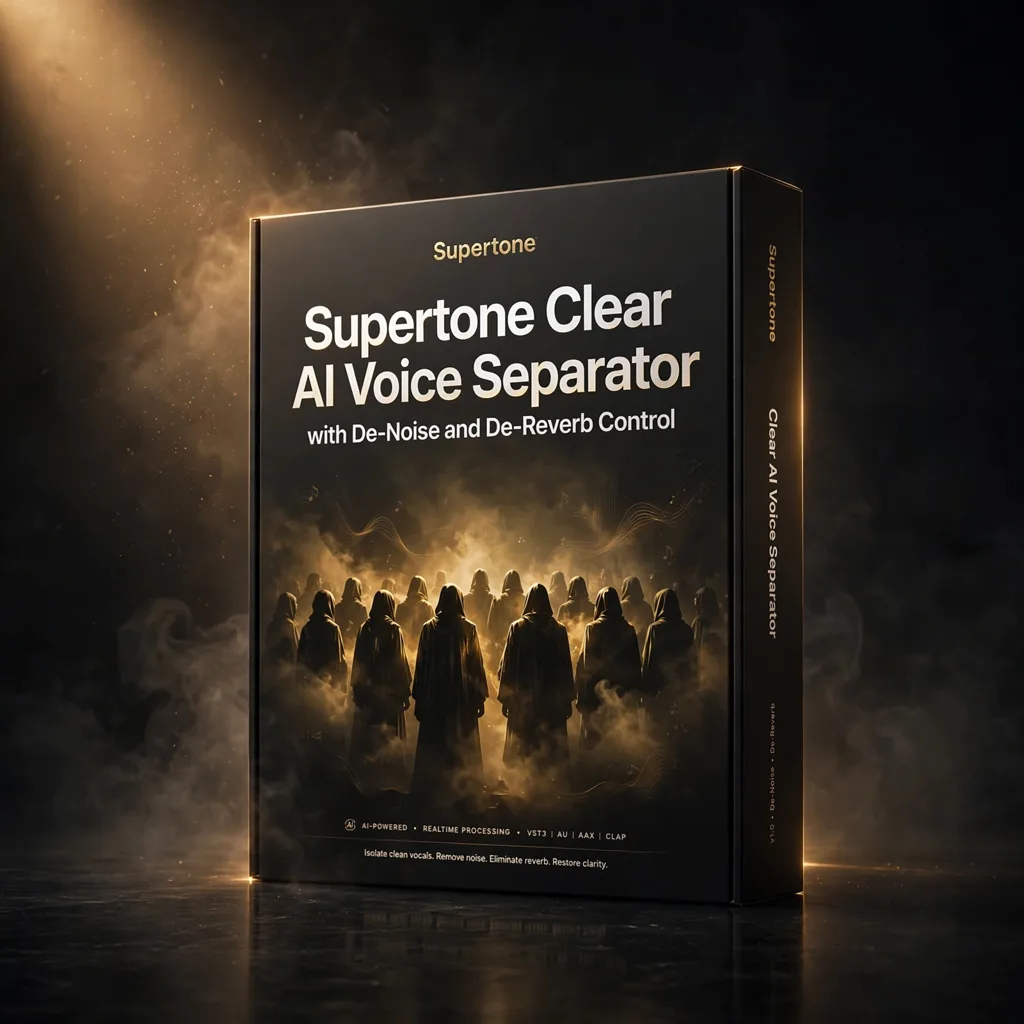


Supertone Clear AI Voice Separator with De-Noise and De-Reverb Control
€29.99
An AI voice separator that splits speech into voice, ambience and voice reverb channels controlled by three knobs, reducing noise and echo with minimal artefacts. Made for dialogue, podcasts, streaming and post-production.
Three Knobs Between You and Clean Dialogue
Room echo and background noise ruin more recordings than bad microphones ever will. Supertone Clear is built to rescue them, using neural network technology to separate a recording into three editable channels — voice, ambience and voice reverb — each governed by its own knob. Turn ambience down and the room falls away; ease the voice reverb back and a boxy bathroom recording tightens into something broadcastable; keep the voice channel forward and the speaker stays present. For dialogue editors, podcast producers and anyone restoring location audio, that simplicity is the product’s whole argument.
The scoring connection is closer than it first appears. Composers increasingly deliver dialogue-adjacent work — podcast themes with spoken intros, documentary cues timed to narration, game voice sessions cleaned before they are mixed under music. A separator that works in real time as well as offline, with minimal digital artefacts according to the source material, belongs in that world. Supertone Clear is aimed at content creators, post-production teams and streamers, but its natural home is any session where a spoken performance must survive an imperfect recording environment and still sit comfortably against a score.
Separation, Metering and Real-Time Work
The three-knob design is deliberate. Voice, Ambience and Voice Reverb map directly onto the three things you actually hear in a troubled recording, so there is no menu of thresholds and ratios to learn before the first rescue attempt. Visual metering showing split and combined channels gives clear insight into what you are editing, which matters when you reduce ambience — you can see the separation working and judge how far to push before the voice itself starts to thin. The AI-driven processing is described as delivering top-tier noise and reverb reduction with minimal artefacts, the crucial qualifier in all restoration work.
Low CPU use supports the dual workflow the source material highlights: live and offline. Used live, Clear can clean a stream or a remote recording session as it happens; used offline, it becomes a post-production restoration step for podcast episodes, voice-over and film and television dialogue. Sample rates of 44.1, 48 and 96 kHz are supported, with a recommended buffer size of 256 or above noted in the specifications — a practical detail for real-time users balancing latency against stability during a broadcast or a directed voice session over a link.
Rescue Work in Real Sessions
Consider the common failures. A podcast guest records in a tiled kitchen; Clear lets you pull the ambience down until the conversation sounds intentional again. A voice-over artist delivers a perfect read from a home booth with one reflective wall; trimming voice reverb restores the close, dry presence clients expect. A documentary interview arrives with location atmosphere baked in; separating the channels lets you keep a trace of place under the narration while the score carries the emotion. User impressions quoted in the source material praise exactly this speech work, calling the noise reduction spectacular for podcast audio.
Streamers and live creators get the same benefit without the edit suite: echo and background noise are eliminated on the fly, so a spare bedroom can pass for a treated room in real time. For composers recording sung or spoken demos at home, Clear offers a quick clean-up before a demo leaves the studio, presenting the writing rather than the room. The discipline is restraint — separation this accessible tempts you to strip a recording bare, but the three-channel design encourages balance, letting you keep enough ambience for the voice to sound human and located.
Formats, Platforms and Session Fit
Supertone Clear is available in AU, VST, VST3 and AAX formats, so it drops into the major DAWs used across music and post work. Platforms are Windows 10 or later in 64-bit form and macOS 10.13 or later, with both Apple Silicon and Intel Macs supported. Those requirements align with the sample-rate support already noted, and the low CPU footprint means it can sit on a dialogue bus inside a large scoring template without competing with sample libraries for resources — a real consideration when a restoration job arrives attached to a cue deadline.
Positioned honestly, Clear is a specialist: it does one job, voice clarity, and organises its entire interface around doing that job fast.




Reviews
There are no reviews yet.