
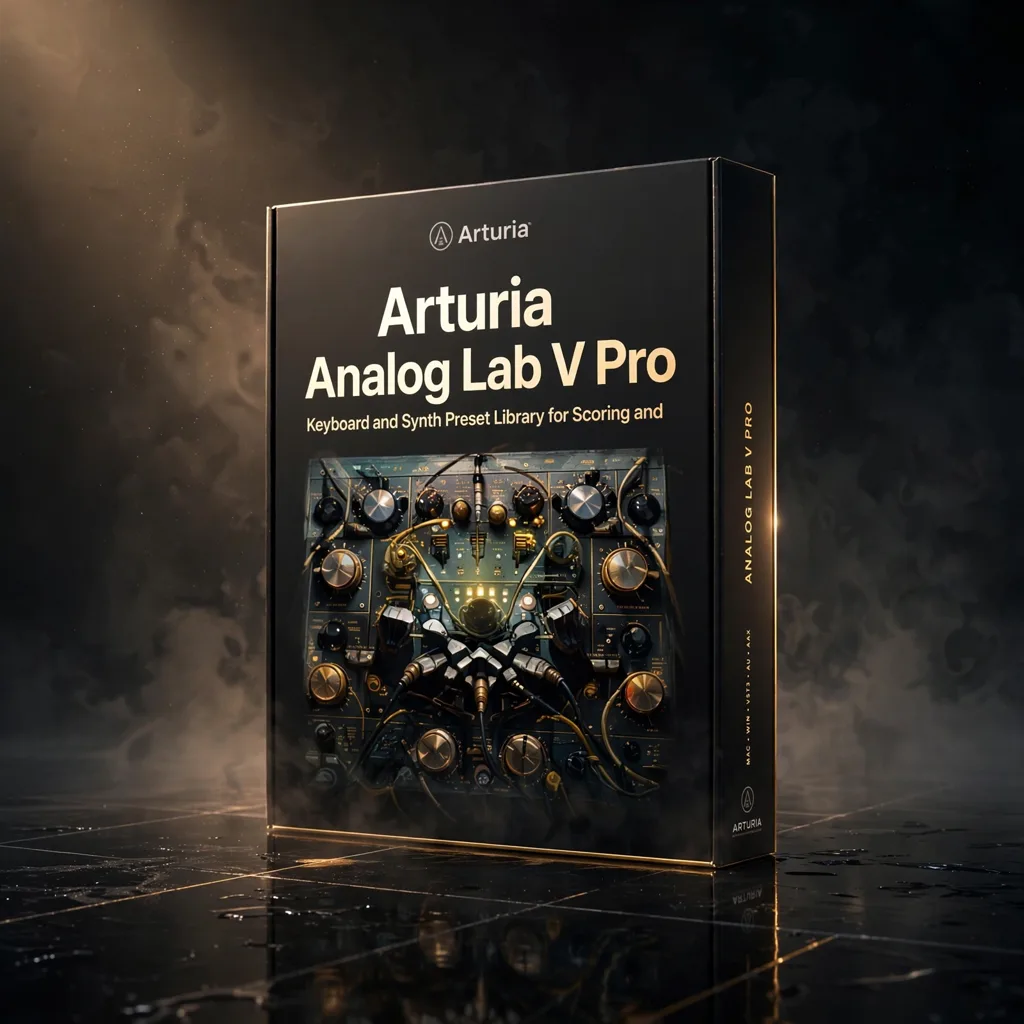

Arturia Analog Lab V Pro – Keyboard and Synth Preset Library for Scoring and Songwriting
€29.99
Arturia Analog Lab V Pro gathers more than 2,000 synth and keyboard presets drawn from the V Collection into one fast, tag-driven browser. Layer sounds in Multi-Sound Mode, shape them with built-in effects, and move from a blank cue to a finished texture in minutes.
Every scoring session eventually hits the same wall: the picture needs a sound now, not after an hour of patch programming. Arturia Analog Lab V Pro answers that pressure by placing more than 2,000 presets from the V Collection behind a single, searchable front door. Instead of opening a dozen separate instruments, you browse one library that spans analogue polysynths, digital classics, pianos, organs and hybrid textures, then load, layer and perform them from the same window. For composers who also write songs, and for producers who increasingly score to picture, that breadth in one place changes how quickly an idea becomes a cue.
Classic Machines, Modelled in Detail
The preset names read like a history of electronic keyboards. Moog, Juno, Prophet, DX7 and CS-80 voices sit alongside pianos, organs and less easily categorised hybrid sounds, so a retro synthwave bass, a felted piano figure and a wide analogue pad can all come from the same instrument. Underneath, Arturia’s TAE and Phi modelling technologies are credited with reproducing the character of the original circuits and acoustic instruments, which matters when a pad has to sit under dialogue without sounding thin or synthetic in the wrong way. The point is not nostalgia for its own sake. It is having recognisable, proven timbres available at the moment an arrangement needs them, with enough low-end weight, top-end air and movement to survive a full mix.
Analogue warmth and digital precision are presented here as partners rather than rivals. The analogue emulations supply drift, saturation and chorus-rich width for themes and ostinatos, while the digital instruments bring the bell-like attacks, glassy layers and evolving spectra that suit science-fiction, technology and dream sequences. Because everything lives in one browser, combining those worlds is straightforward, and a sound that begins as a period keyboard part can be steered toward something contemporary simply by choosing a different partner preset.
Finding and Layering Sounds at Scoring Speed
Browsing is tag-based, with filters and instant preview, so you can narrow thousands of presets by type, character or genre without auditioning them one by one in context. That discipline pays off on deadline work, where a director’s note such as warmer, darker or more fragile has to translate into a shortlist quickly. Once you have candidates, Multi-Sound Mode lets you combine instruments into layered, cinematic hybrid tones: a piano attack over a synth body, an organ sustained beneath a pad, or two contrasting synths split or stacked for a lead that answers the picture. Full MIDI mapping, with Arturia KeyLab and MiniLab controllers in mind, keeps hands on keys and encoders rather than on a mouse.
A built-in effects suite of reverbs, delays, filters and modulation tools finishes sounds inside the instrument, which helps when you are sketching and do not yet want to commit to a full mix chain. In a cue-writing workflow that might mean adding a long delay tail to suggest distance, filtering a pad so it leaves room for strings, or giving a bass sequence enough movement to carry a montage. The instrument is described as optimised for low CPU use, so those layers can accumulate in a large template without forcing you to freeze tracks at every step.
Formats, Systems and Requirements
Analog Lab V Pro runs as VST, VST3, AU and AAX, and the listed hosts include FL Studio, Ableton Live, Logic Pro, Cubase, Pro Tools and Studio One, covering the DAWs most scoring and production work passes through. It supports macOS 10.13 or later on Apple Silicon and Intel, and Windows 10 or 11 in 64-bit. The stated requirement is 8GB of RAM, with 16GB recommended, and 4GB of storage. For a composer building a template, those modest demands make it an easy permanent resident: a single plugin slot that can supply a synth bass for a trailer cue in the morning, an organ for a drama scene at noon, and a hybrid piano texture for the end credits at night, all without changing instruments or breaking concentration.
Related products


FREQ-FX by Dezert Audio — Eight Analogue-Modelled Modules for Colour, Width and Movement
FREQ-FX is Dezert Audio's first effects plug-in, from a developer known for sampled instruments built on rare hardware. Its eight analogue-modelled modules target texture, movement, width, depth and distortion — the qualities that separate a cue that is technically correct from one that feels alive.


Reviews
There are no reviews yet.