
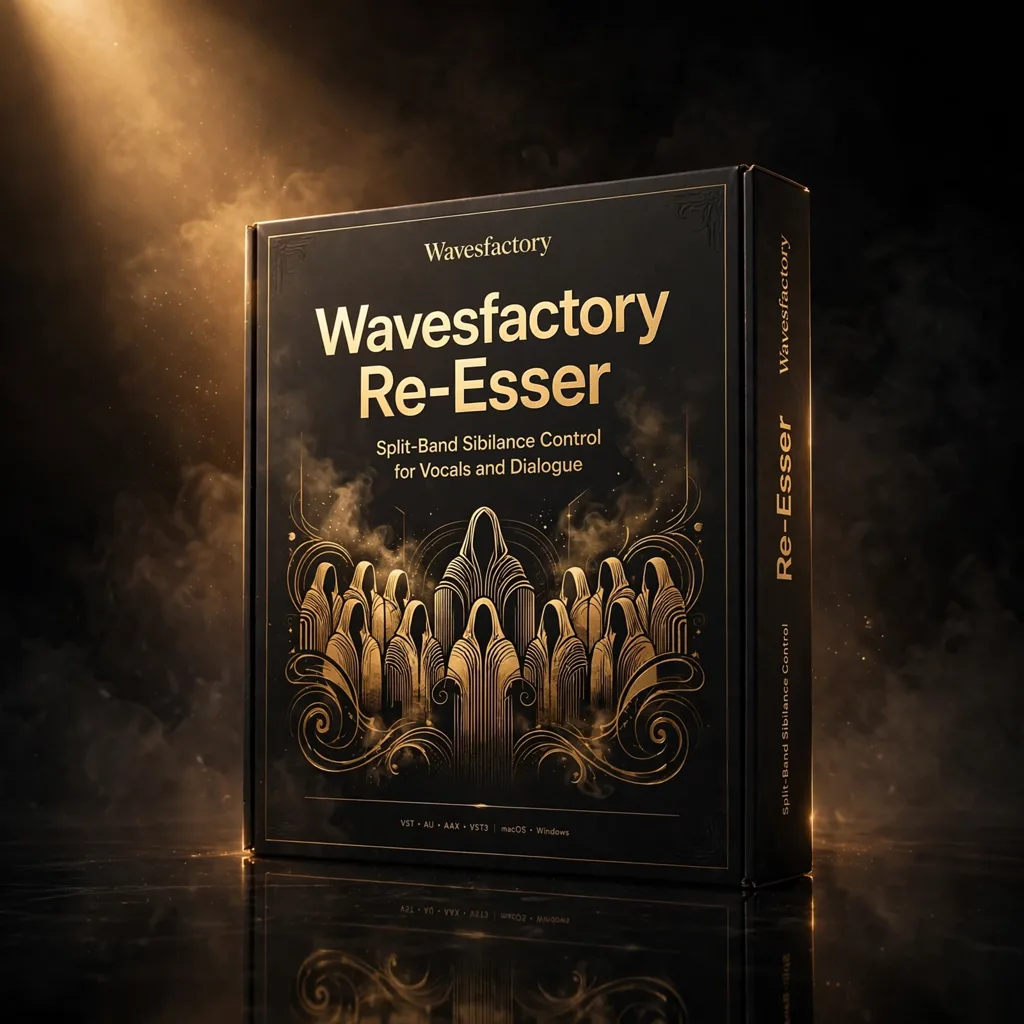

Wavesfactory Re-Esser – Split-Band Sibilance Control for Vocals and Dialogue
€29.99
Wavesfactory Re-Esser removes sibilance with split-band precision, leaving the frequencies around the problem untouched. With intelligent detection, a listen mode and mid-side processing, it is built for lead vocals, sung score cues and dialogue that must stay bright and intelligible.
Sibilance is a small problem that can make an otherwise finished mix feel amateur. A vocal that turns harsh on every S, or dialogue that spits through a streaming encode, draws attention away from the performance and towards the processing. Wavesfactory re-esser is designed to remove that distraction without the familiar side effects. The source describes advanced split-band processing and an intelligent detection algorithm that target the exact sibilant energy while leaving surrounding frequencies natural. For composers working with singers, narration or dialogue-led content, that transparency is the entire point.
Split-Band Detection Explained
Conventional de-essers often reduce a broad region whenever sibilance is detected, which can dull air and presence or create a lispy quality. Re-Esser offers both wideband and split-band modes, with split-band operation presented as the route to maximum transparency on demanding material. In split-band mode, only the exact frequency range causing the problem is processed. Frequencies above and below that band remain unaffected. The result, in the source’s terms, is de-essing that sounds as though the sibilance was never there, rather than a vocal with a hole cut into its top end.
Precise frequency control allows targeting of standard S and SH sounds as well as more specialised instrument resonances. Independent threshold and reduction controls separate the question of when processing begins from how much it applies, while adjustable attack and release shape how naturally that reduction moves. A listen mode isolates only the frequencies being processed, so you can tune detection by hearing the problem directly instead of guessing. That single feature saves time and prevents the common error of processing bright consonants or cymbal energy that was never sibilance in the first place.
Vocals, Dialogue and Beyond
Lead vocals are the obvious application, and the source names them first. In a song cue for film or television, the singer often sits in front of a full arrangement and cannot afford to lose presence every time a sibilant arrives. Re-Esser aims to preserve that air and sparkle while removing the peak that makes a listener reach for the volume. Dialogue for broadcast and podcast work is another named use, where clean, professional speech depends on consonants remaining intelligible without becoming fatiguing over a long programme.
The usefulness does not end with voices. Acoustic guitars and cymbals can produce harsh high-frequency resonances that need control without tonal damage, and synthesizer leads can carry sharp digital energy in a similar range. Mid-side processing adds a mastering and stereo-bus dimension, allowing independent sibilance control on mid and side signals. In a score mix, that could mean treating a centred vocal or featured instrument more firmly than the wide elements around it. Used on the stereo bus, the same control can address broad-spectrum harshness across a complex mix, provided it is applied with restraint and checked against the untreated version.
Formats and Practical Facts
The source lists VST3, AU and AAX on macOS 10.13 and later and Windows 10 and later, with compatibility across Logic Pro, Pro Tools, Ableton Live, Cubase, FL Studio and other major DAWs. Licence key and installer are described as delivered immediately after purchase. No additional technical specifications are given in the source material.
The best de-essing is unremarkable. The vocal stays present, the dialogue stays clear, and nobody in the audience thinks about processing at all. Re-Esser is built around that standard, using targeted detection, split-band control and careful timing options to solve a narrow problem properly. In a composer’s toolkit full of dramatic instruments, a tool this focused earns its place by protecting the performances everything else is there to support.
Work in small passes rather than one aggressive setting. Set the detection band with listen mode, reduce only the peaks that draw attention, then play the full mix again. Sibilance control judged in context almost always ends up gentler, brighter and more believable.
Related products

StandardCLIP by SIR Audio Tools — The Clipper That Lets You Tune Its Own Oversampling
Most clippers hide the filtering that decides whether clipping sounds like loudness or like distortion. StandardCLIP exposes it: oversampling up to 256x, linear- or minimum-phase filters you can tune yourself, a variable clip shape, and an assistant that measures your loudest passage and sets safe output gain.




Reviews
There are no reviews yet.