
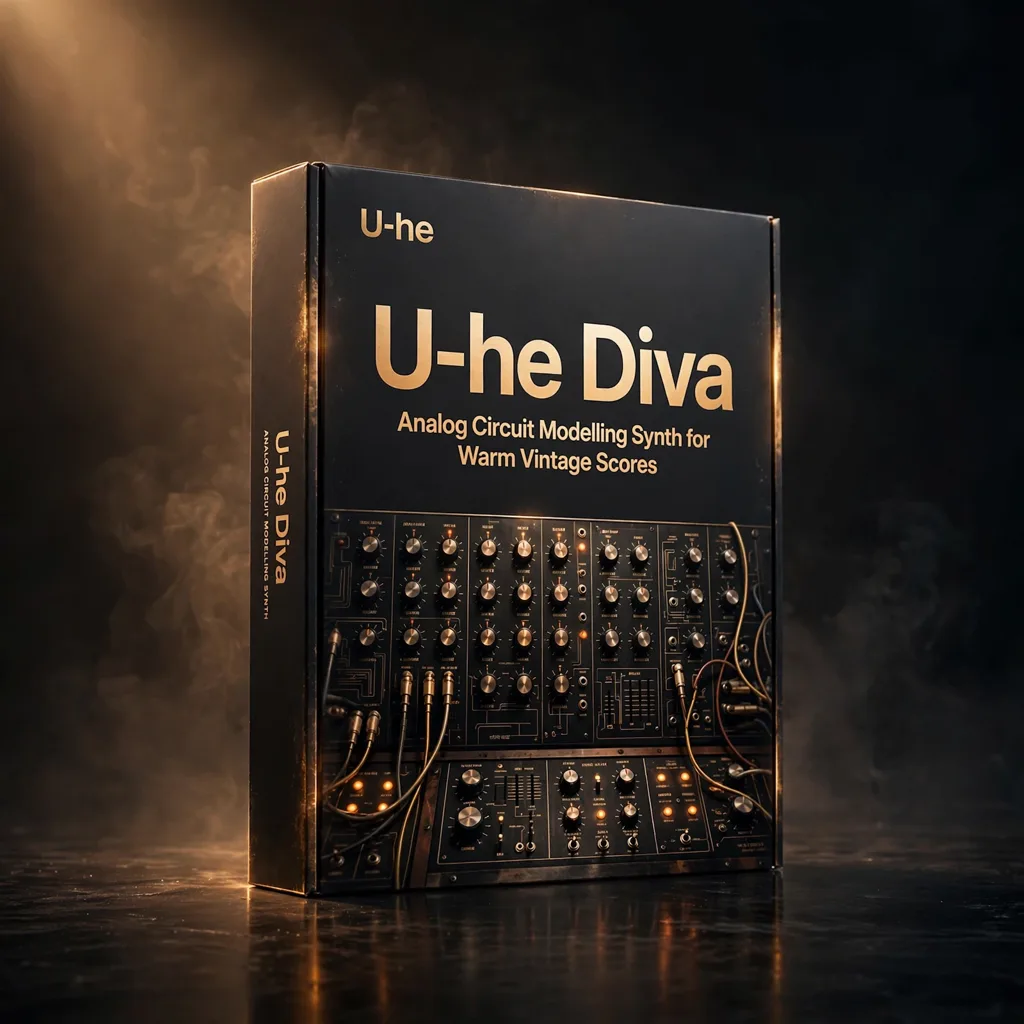


U-he Diva – Analog Circuit Modelling Synth for Warm Vintage Scores
€29.99
U-he Diva models the oscillators, filters and envelopes of classic analog hardware and lets you combine those modules into your own instrument. The result is a virtual analog synth with the warmth and unpredictability that period, synthwave and dramatic scores call for.
Diva exists because a sampled waveform is not the same thing as a living circuit. U-he’s virtual analog synthesizer models the nonlinear behaviour of classic hardware at component level, so oscillators interact, filters saturate and envelopes respond with the small imperfections that make analog instruments feel played rather than rendered. For composers, that character is a storytelling tool. A Diva bass under a period drama, a drifting pad in a science-fiction cue or a bright lead carrying a synthwave theme all borrow credibility from hardware the audience may never have seen but instinctively recognises. This is not a museum piece, though; it is a flexible modern instrument built from vintage parts.
Circuit Behaviour, Not Just Samples
Diva’s architecture is modular in spirit: you select oscillator models, filter types and envelope generators inspired by different classic instruments and combine them into a synth that never existed as a single hardware unit. Vintage ladder filters sit alongside multimode designs, and the flexible modulation system lets you animate the result for modern productions. Integrated effects extend the patches without leaving the plugin. The extensive preset library shows the range clearly, from faithful analog basses and leads to pads and textures aimed at contemporary work. Because the components respond like circuits, small performance gestures, detuning, filter movement, a pushed envelope, produce the gradual, organic change that sampled instruments often struggle to imitate convincingly.
Period Colour and Modern Drama
Diva earns its keep where a score needs a synth to feel like a member of an ensemble rather than a layer pasted on top. Its warmth sits naturally beside strings and guitars, and its instability can be used deliberately, a slow drift for nostalgia, a harder edge for threat. For scoring, a synth earns its place when it does something an acoustic instrument cannot: hold an uneasy stillness, bend pitch against a fixed orchestral chord, or carry a pulse that feels mechanical rather than human. Start with the dramatic job, not the preset name. Audition sounds against picture, at the level they will actually sit in the mix, because a patch that dazzles soloed may blur under strings or dialogue. Shape attack to match the cut, keep low frequencies clear of the bass line, and record modulation as automation so the sound develops across the cue instead of repeating statically. A small family of related patches, varied scene by scene, will give a series or game world a recognisable sonic identity without sounding repetitive.
Print a few contrasting variations of a key patch before committing. Directors often choose by feel in the room, and having a darker, a brighter and a drier option ready turns a revision into a quick decision.
Platforms and Formats
On macOS, Diva requires version 10.13 or later and runs on Intel and Apple Silicon machines in AU, VST3 and AAX formats. On Windows it supports Windows 10 and 11 in VST3 and AAX. The source listing confirms Mac and Windows compatibility as a download for both platforms. That format coverage places Diva comfortably in Logic Pro, Cubase, Pro Tools and other major scoring hosts, and its preset library and integrated effects mean a fresh install is productive immediately, before any time is spent building custom module combinations of your own.
For Composers Who Miss Hardware
Pick Diva when the brief mentions warmth, the seventies, analog, retro or simply real. Electronic producers use it for basslines and leads, but for film, ambient and synth-based scoring it offers something rarer: a software synth with enough genuine hardware behaviour that a simple part, played well, can carry a scene on its own.
When time is short, a familiar tool used well will beat an unfamiliar one used cautiously almost every time. Listen again the next morning at low level; choices that still communicate quietly are usually the choices worth keeping. The most useful setups are the ones you can recall, adjust and reprint without stopping to rebuild your session.





Reviews
There are no reviews yet.