
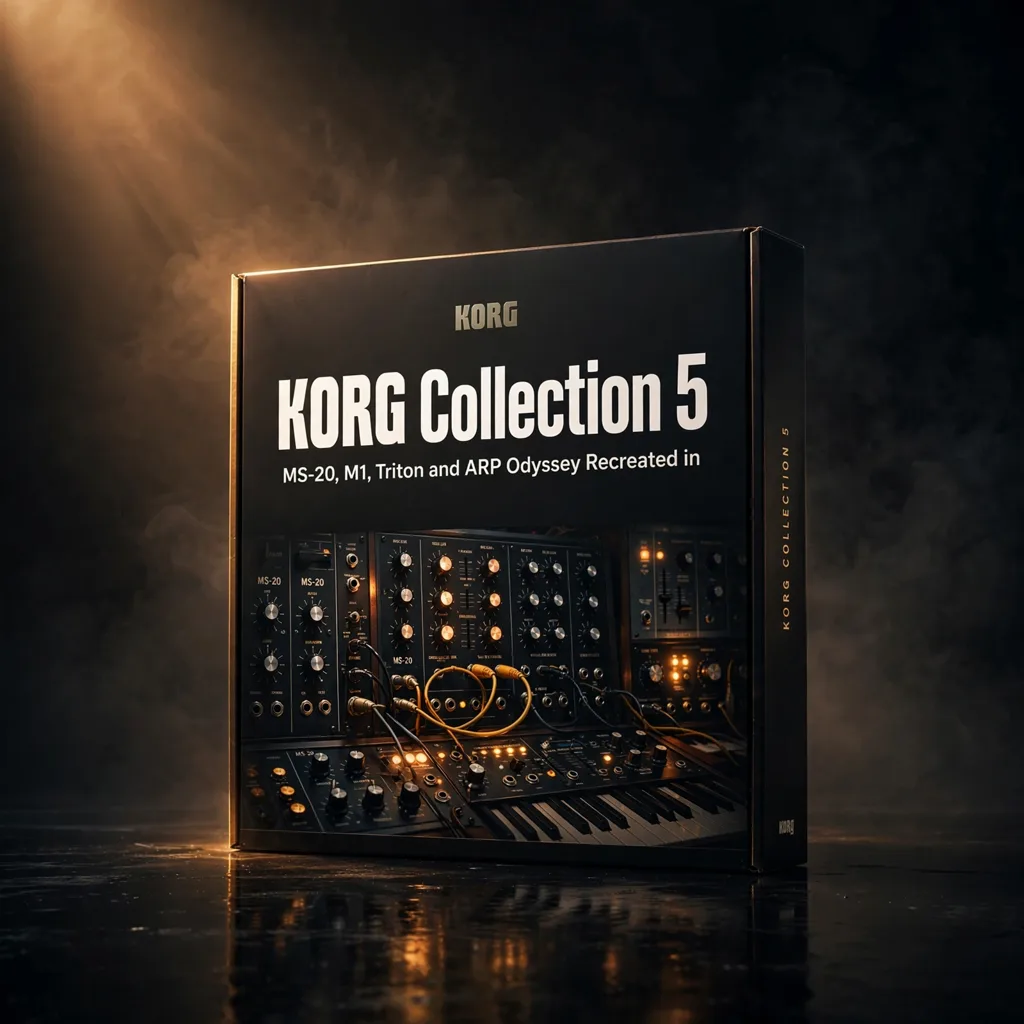

KORG Collection 5 – MS-20, M1, Triton and ARP Odyssey Recreated in Software
€49.99
KORG Collection 5 recreates landmark KORG instruments in software, including the MS-20, Polysix, Mono/Poly, M1, Triton and ARP Odyssey. Analogue circuit modelling, modern enhancements and over 3,000 presets make it a wide-ranging keyboard history for producers and composers.
Certain keyboards define entire periods of recorded music, and KORG built more of them than most. KORG Collection 5 gathers faithful software recreations of those instruments into one bundle, moving from the raw analogue aggression of the MS-20 to the workstation sounds of the M1 and Triton that shaped 1990s production. For a composer, that range is unusually useful. Period accuracy matters in scoring, whether a cue must sound like a 1970s thriller, a 1990s television theme or a contemporary production borrowing from both, and this collection lets you work with the actual instrument families that created those sounds.
Six Landmarks, Each With Its Own Job
The MS-20 brings patchable, aggressive analogue synthesis, the sort of snarling filter behaviour that suits tension, horror and electronic sequences. The Polysix offers six-voice polyphony with lush pads and warm basses, a natural underscore instrument. The Mono/Poly, a monophonic and polyphonic hybrid, is aimed at bold leads that need to cut through an arrangement. The ARP Odyssey recreation covers the classic duophonic synthesizer tradition, while the M1 and Triton represent the digital workstation era, with the layered, instantly recognisable sounds that carried countless hits and broadcast themes. Triton and M1 expansion cards are included, extending those workstations with the famous sounds used on hit records.
Sound quality rests on analogue modelled circuitry, referred to as CMT, intended to deliver realistic analogue warmth, alongside modern enhancements such as extended polyphony, high-resolution effects and filter improvements. Those additions matter in practice. A vintage pad that ran out of voices on hardware can sustain a full orchestral-adjacent arrangement here, and cleaner effects let period sounds sit in a modern mix without apology.
Presets, Workflow and Performance Use
More than 3,000 factory presets cover EDM, pop, hip-hop, cinematic and other ground, giving you historically grounded starting points rather than generic approximations. Customisable, resizable interfaces and full MIDI automation support expressive, real-time control, so a filter sweep, a workstation layer change or a lead’s character can be performed and recorded as part of the cue rather than drawn in afterwards. Low CPU usage is emphasised, which helps when several of these instruments run inside a large scoring template alongside orchestral libraries.
The collection also rewards composers who write their own sounds. Deep sound design capabilities allow custom patches to be built from scratch or developed from presets, so a programme can develop its own keyboard identity across episodes, returning to the same MS-20 bass or Triton texture as a motif. Electronic producers, beatmakers and live performers are all named among its users, and the common thread is authenticity under modern working conditions.
Formats and System Requirements
KORG Collection 5 is available in VST3, AU and AAX, for macOS and Windows in 64-bit, and works with Ableton Live, FL Studio, Logic Pro, Pro Tools, Cubase, Studio One and other major DAWs. On Mac it requires macOS 10.14 or later with Intel or M1 or M2 processors; on Windows, Windows 10 or later with an Intel or AMD 64-bit processor. RAM requirements for both platforms are 8GB, with 16GB recommended, and licensing is listed as perpetual or subscription. As a single purchase covering analogue monosynths, a polyphonic classic, a duophonic landmark and two defining digital workstations, it functions as a working museum you are allowed to play, record and rewrite for the screen.
Considered as a scoring resource, the collection’s real gift is casting. Each instrument brings a ready-made era and attitude, so choosing between them is closer to choosing instrumentation than choosing presets. The MS-20 can be cast as menace, the Polysix as warmth and memory, the Mono/Poly as the confident lead, and the M1 and Triton as the sound of broadcast modernity at its most assured. A composer can move a single melodic idea between those casts and hear the scene change meaning each time, which is a powerful writing tool. Few bundles offer that kind of directorial control over period and mood from one installation.





Reviews
There are no reviews yet.