
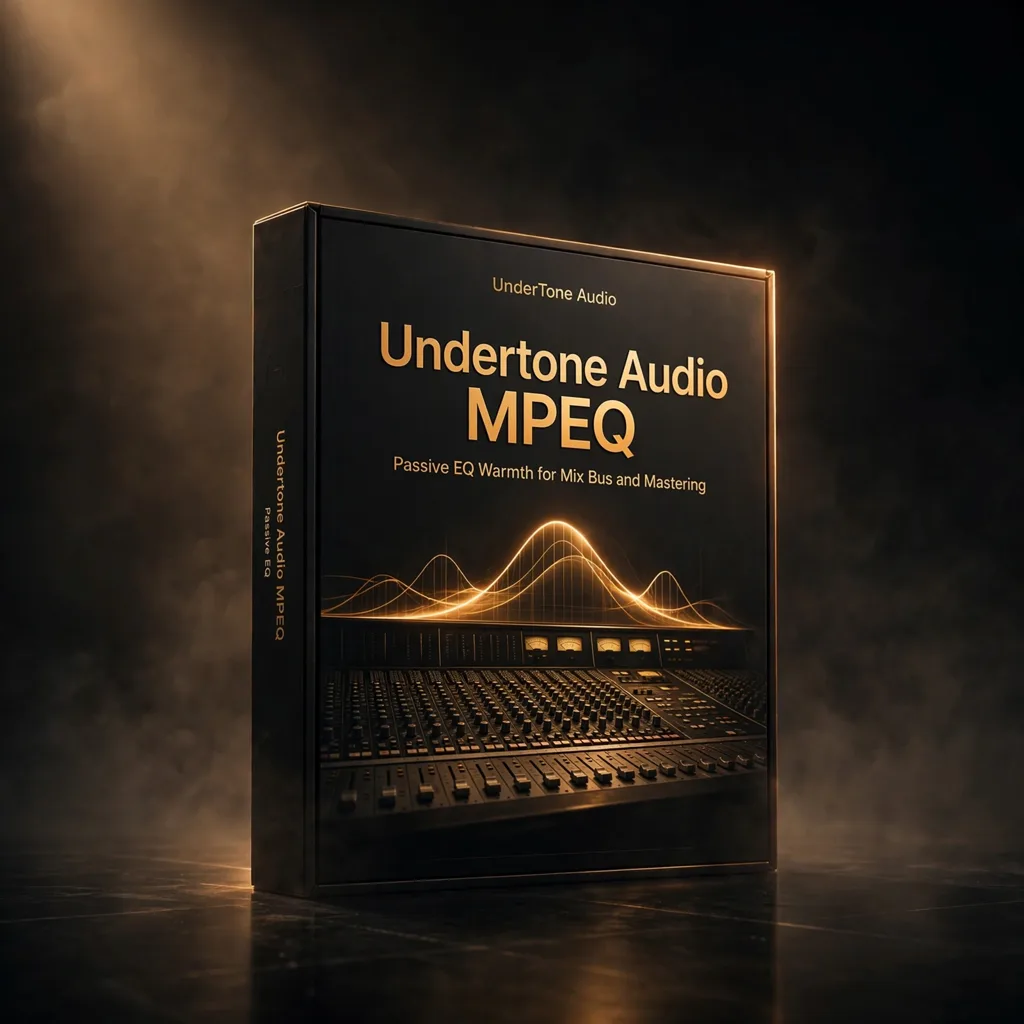


Undertone Audio MPEQ — Passive EQ Warmth for Mix Bus and Mastering
Original price was: €129.00.€39.99Current price is: €39.99.
The undertone audio mpeq passive eq brings the broad, musical curves of passive hardware to mixing and mastering, without harshness or digital artefacts. Use it for gentle high-end air, controlled low end and midrange shaping on voices, orchestral recordings and the stereo bus.
Most equalisers in a DAW are scalpels; a passive equaliser is a hand on the shoulder. Undertone Audio MPEQ is a professional passive EQ plugin for Windows and Mac, modelled on the design philosophy of Undertone Audio’s renowned hardware approach, and built for the kind of tonal shaping where the goal is not to fix a frequency but to make a whole recording feel more like itself. Its curves are described as smooth, broad and musical, with transparent processing and analogue warmth — qualities that suit orchestral material, acoustic recordings and finished mixes, where aggressive, narrow EQ moves are usually the wrong answer.
Why Passive Curves Sound Different
Passive equalisation shapes tone with wide, gentle curves and a natural frequency response, and the source lists the practical consequences: smooth tonal balance, analogue warmth, transparent processing, gentle high-end enhancement and broad midrange shaping. In plain terms, a high-frequency boost on a design like this tends to add air and openness across a region rather than spotlighting one narrow band, and low-end control can tighten or support the foundation without the resonant ring that narrow boosts introduce. MPEQ is specified with high-resolution audio processing, high dynamic range processing and low CPU usage, in a modern user interface designed for precise frequency control and a fast workflow. That combination — hardware-style behaviour, digital convenience — is the product’s whole argument. It is intended equally for subtle mastering adjustments and for creative mixing, so the same tool that polishes a finished score can also warm an individual stem during the mix, keeping the tonal language of a production consistent from first balance to final master.
Scoring, Mixing and Mastering Applications
The documented applications are usefully concrete. On vocals, MPEQ adds presence, warmth and clarity while maintaining a natural tone — important for a sung title song or a featured soloist recorded against an orchestra. On drums it can enhance kick weight, snare punch and cymbal brightness; on bass, improve definition while preserving warmth and musicality. Acoustic instruments are a natural home for passive curves: guitars, pianos, strings and orchestral recordings can be shaped with transparent adjustments that respect the recording. On the stereo bus, subtle tonal enhancement improves cohesion across a full mix — the quiet final decision that makes separate cues feel like one score. Mastering engineers are described as using it for final tonal balance, high-end air, low-end tightening, midrange control, stereo bus enhancement, album mastering and broadcast preparation. Because the interface is straightforward and latency is low, it also fits the reality of a composer’s mix session, where an EQ that invites endless tweaking is a liability and one that reaches the right sound in two moves is an asset.
Formats, Platforms and Placement
MPEQ runs in VST3, AU and AAX formats on Windows and Mac, with the source listing Windows 10 and Windows 11, Intel and Apple Silicon Macs, and the latest macOS versions. Hosts named include FL Studio, Ableton Live, Cubase, Studio One, Logic Pro, Reaper, Nuendo and Pro Tools. Its stated uses span mixing, mastering, vocal processing, drum mixing, acoustic instruments, electric guitars, bass enhancement, stereo bus processing and podcast production. Position it in your own workflow where broad strokes belong: after corrective work has been done with a precise EQ, at the point where the question changes from ‘what is wrong here?’ to ‘how should this feel?’. For orchestral and hybrid scores especially, where dozens of recorded and sampled sources must agree tonally, that kind of musical, forgiving equalisation is often the fastest route to a finished sound.
That quality — decision-making by feel rather than by graph — is what engineers usually mean when they call an equaliser musical, and it is the character MPEQ is built to deliver in software form.







Reviews
There are no reviews yet.