
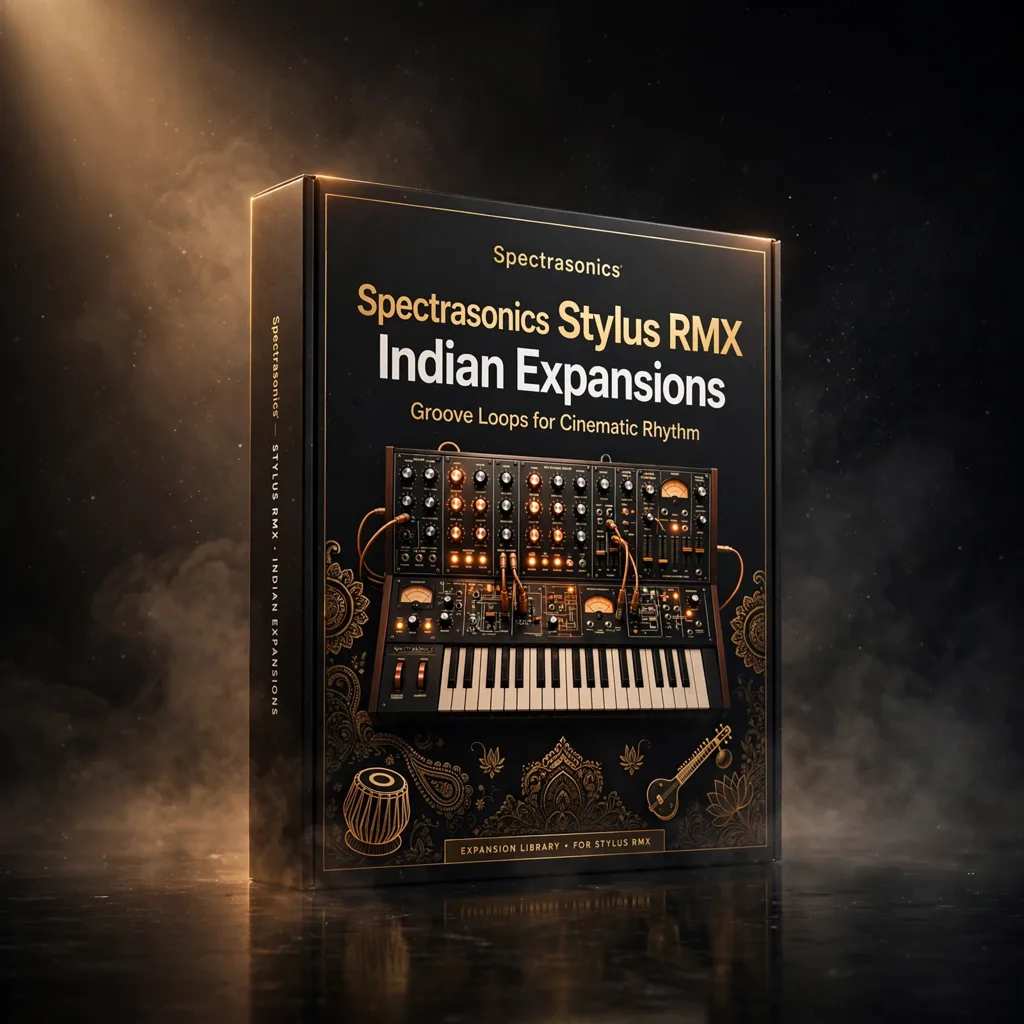

Spectrasonics Stylus RMX Indian Expansions – Groove Loops for Cinematic Rhythm
€29.99
Spectrasonics Stylus RMX is a real-time groove instrument built around loop manipulation rather than simple playback. Groove Control, the Chaos Designer and drag-and-drop MIDI let you reshape thousands of loops into rhythmic parts that follow your cue.
A loop dropped into a cue unchanged sounds like exactly that. Stylus RMX was designed around a different assumption: that rhythmic material should be an instrument, sliced, re-triggered and reshaped in real time until it belongs to your track. Spectrasonics built the plugin around its Groove Control technology, a large core library and a performance workflow that lets composers and producers treat loops as raw material. This listing carries the Stylus RMX name with its Indian Expansions branding; the detailed source specification supplied for it describes the Stylus RMX groove engine and core library, so the description below concentrates on that documented engine, its library size and its workflow rather than inventing expansion-specific content.
Loops You Play, Not Just Play Back
The core library is 7.4GB of loops spanning electronic, cinematic, organic and percussion-based grooves, recorded and processed to a high standard. Groove Control lets individual beat elements inside a loop be manipulated separately, so a pattern can be tightened, loosened or rebuilt around your own kick and snare choices. Real-time MIDI triggering supports live remixing and performance-style writing, while the Chaos Designer introduces controlled randomisation for human, evolving variation. You can drag and drop your own audio files into the environment, process material with filtering, EQ, compression and modulation effects, and run the instrument multi-timbrally with multi-output routing for proper mixing. The time-stretching quality is a large part of the appeal: grooves survive tempo changes that would tear lesser loop tools apart.
Rhythm That Follows the Edit
For picture, the practical gift is editability. Drag MIDI from a groove straight into your DAW timeline, mute or re-voice individual elements when dialogue arrives, and let a pattern evolve across a long scene instead of looping identically. Rhythmic material for picture has to survive editing. Scenes are shortened, shots are swapped, and a groove that only works in one exact arrangement becomes a liability. Build parts you can thin out, extend or mute in sections, and keep a version with the busiest elements removed for dialogue-heavy passages. Match the internal swing of the part to the movement on screen rather than quantising everything to the grid; footsteps, machinery and camera moves all carry their own rhythm. Where a cue needs cultural or geographical colour, treat it as composition, not decoration: choose the pattern, register and dynamics to suit the character and the moment, and let the rhythm support the scene instead of advertising itself over it.
Keep individual elements on separate tracks wherever possible. When picture changes, muting one layer is faster and cleaner than rebuilding the entire rhythm from scratch.
Formats and System Needs
Stylus RMX is supplied in VST, AU and AAX formats, 64-bit only, and works with hosts including Ableton Live, FL Studio, Logic Pro, Cubase, Pro Tools, Studio One, Reason, Bitwig and Reaper. macOS requires 10.13 or higher, with Intel and Apple Silicon supported; Windows requires version 10 or higher in 64-bit. The listed requirements are light: a minimum of 2GB of RAM with 4GB or more recommended, and 15GB of free storage for the installation as specified in the source material. CPU use is described as optimised for complex projects, which suits its role as a multi-timbral rhythm layer inside larger scoring sessions.
For Composers Who Think in Grooves
Stylus RMX suits beatmakers, sound designers and composers who build cues from rhythm outward: action sequences, montages, contemporary drama and any scene where percussion carries momentum. If your loop library feels like a cupboard of finished meals, this is the tool that turns it back into ingredients.
Listen again the next morning at low level; choices that still communicate quietly are usually the choices worth keeping. The most useful setups are the ones you can recall, adjust and reprint without stopping to rebuild your session. Treat dynamics as part of the composition, not as something to be repaired later in the mix. A cue is a conversation with the picture, and every production choice should answer something the scene is asking.
Related products



Sonic Atlas Bundle – Atlas Platform with Bollywood Gold, Desi Dance and Punjabi Pulse
The Sonic Atlas Bundle brings the Atlas platform together with Bollywood Gold, Desi Dance and Punjabi Pulse for composers who need South Asian colour that plays naturally from a keyboard. Sitar, tabla, bansuri and a full rhythm section sit inside one expressive player built for film, TV and fusion work.



Dede Sound Premium Bundle – Authentic Oriental Kontakt Library
Dede Sound Premium Bundle is a professional world instrument Kontakt library featuring authentic Middle Eastern, Arabic, Turkish, and Indian instruments. Designed for composers, producers, and sound designers, this deeply sampled collection gives your music rich ethnic character and cinematic expression. Perfect for film scores, ambient productions, and cultural fusion compositions.
Reviews
There are no reviews yet.