
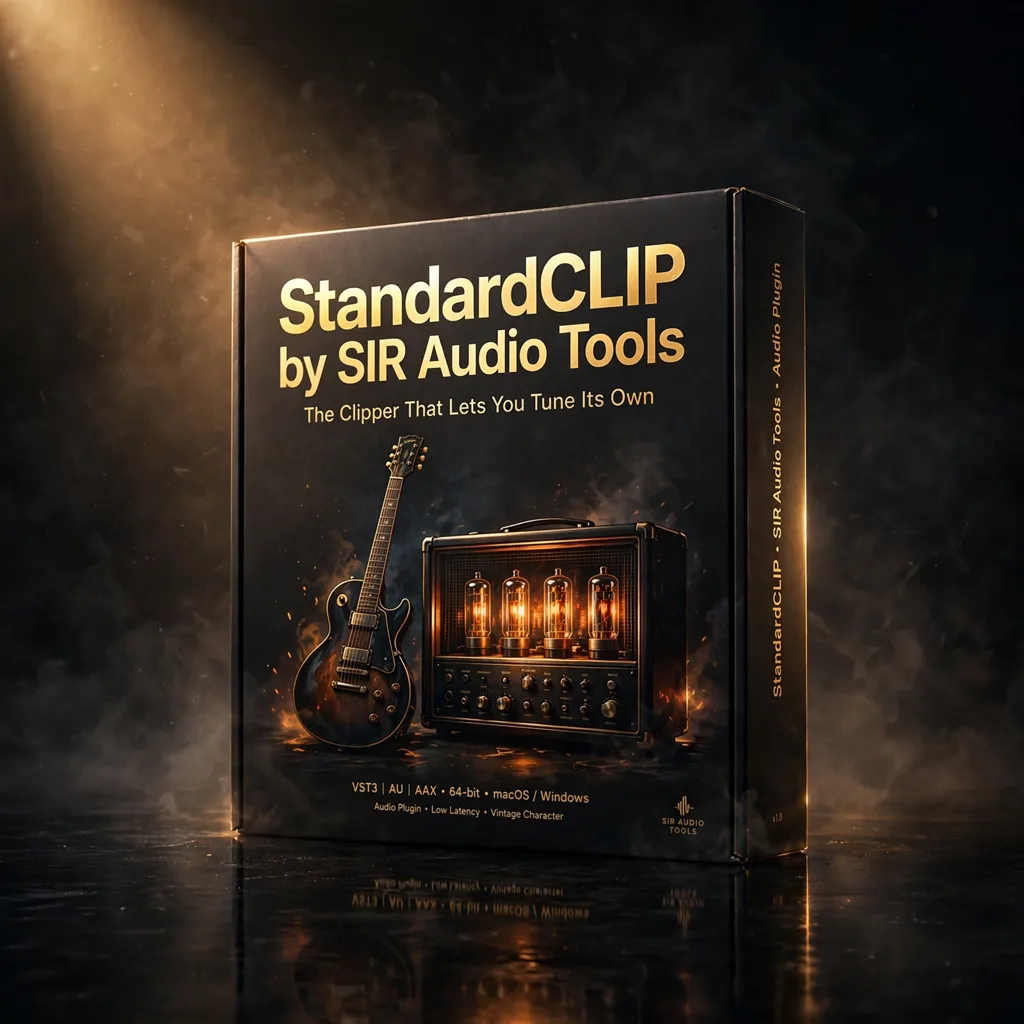

StandardCLIP by SIR Audio Tools — The Clipper That Lets You Tune Its Own Oversampling
Original price was: €25.00.€20.00Current price is: €20.00.
Most clippers hide the filtering that decides whether clipping sounds like loudness or like distortion. StandardCLIP exposes it: oversampling up to 256x, linear- or minimum-phase filters you can tune yourself, a variable clip shape, and an assistant that measures your loudest passage and sets safe output gain.
Clipping itself is simple arithmetic — anything above the ceiling is truncated, and truncation generates harmonics. Whether a clipper reads as extra loudness or as obvious distortion depends almost entirely on how that truncation is filtered, which is precisely the stage most plug-ins bury behind a single quality switch. StandardCLIP, developed by Christian Knufinke of SIR Audio Tools and now at version 1.6 after years of incremental refinement, takes the opposite position: the oversampling architecture is presented as a set of controls for the engineer to decide.
You Choose the Oversampling Trade-Off
Oversampling runs up to 256x, far beyond the 4x or 16x ceilings common in comparable tools. More importantly, you choose whether the up-sampling and down-sampling filters operate in linear-phase or minimum-phase mode, and you set their quality and cut-off frequency yourself. Neither phase choice is universally right — linear-phase introduces pre-ringing, minimum-phase introduces phase shift — so StandardCLIP turns an inherited default into a decision, which is exactly what a mastering engineer finishing a dynamic orchestral recording needs. The clip shape itself is continuously variable, from a hard-limiting brick wall through to smooth soft saturation, and a Ratio 2:1 clip mode offers a gentler, more compressor-like transfer curve when full clipping is too blunt.
Two Jobs: Loudness Stage and Harmonic Generator
The developer documents two intended uses. The first is the familiar one in score delivery, where loudness targets are unforgiving: a dynamics stage in the master chain that raises volume by removing peaks. The second treats the odd harmonics clipping produces as the desired outcome — a harmonic generator adding edge and density to a bus or a stem. Metering supports both jobs properly. The output waveform display overlays the pre-reduction level in red against the output, so the depth of clipping is visible frame by frame, and a half-waveform view expands the vertical scale for fine adjustment. Input and output RMS metering is provided, with RMS Full Scale Sine (+3 dB) referencing available, alongside maximum peak and RMS displays that reset with a click. The Output Gain Assistant addresses an under-discussed problem: oversampling can reconstruct peaks above the ceiling after down-sampling, so the assistant listens to your loudest section and sets the output fader to the highest value that guarantees no sample exceeds it.
Formats and Licensing
Format coverage is unusually wide: VST, VST3, Audio Unit and AAX, in 64-bit for Intel and native Apple Silicon Macs and for Windows, with a 32-bit Windows build retained for older sessions. Pro Tools version 11 or newer is supported, and latency compensation is maintained correctly when the plug-in is bypassed, including in Cubase. Authorisation is by licence key with no dongle, a fully functional demo build is distributed so the plug-in can be evaluated on real material, and a detailed manual covers the signal diagram and oversampling configuration. For engineers who have ever wondered why two clippers at identical settings sound different, this is the tool that makes the reason adjustable.
The same transparency about its own processing makes StandardCLIP a useful teaching tool as well as a mastering stage. Watch the red pre-reduction trace against the output while sweeping the oversampling factor, and the audible difference between filter choices stops being folklore and becomes something you can see as well as hear — pre-ringing on transient-heavy orchestral hits with linear-phase filtering, or the subtler phase consequences of the minimum-phase alternative on sustained material. In delivery work, where a score may be mastered for cinema, streaming and trailer use at different loudness targets, that control lets one processor serve several specifications honestly instead of forcing a compromise setting. The 2:1 ratio mode also deserves more use than it gets: placed before a final limiter, it can take the sharpest peaks off a percussion-heavy cue with a transfer curve closer to gentle compression, leaving the limiter less work and the transients more of their original shape.
Related products

Legend Channel by PAA Audio — One British-Style Strip for Vocal, Strings and Rhythm Tracks
Legend Channel puts an entire British console channel into one window: a transformer-driven mic and line preamp, filters, a four-band EQ, a compressor and a gate/expander. For a composer mixing their own cues, that is the whole track chain — colour, shape and control — without stacking five plug-ins.






Reviews
There are no reviews yet.