
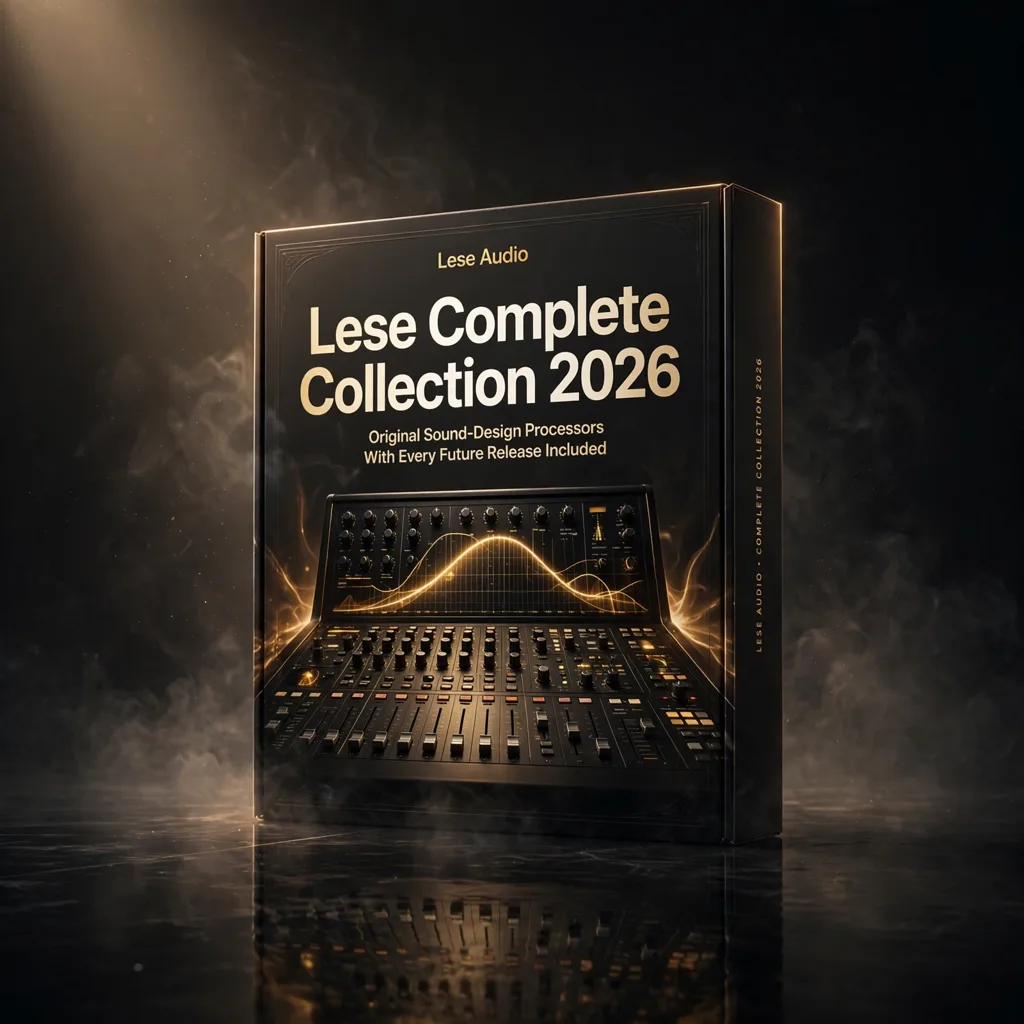

Lese Complete Collection 2026 — Original Sound-Design Processors With Every Future Release Included
Original price was: €349.00.€59.99Current price is: €59.99.
Lese does not model famous hardware, because its processors never existed as hardware. The complete collection gathers a temporal smoother, a stochastic reverb, a codec degradation tool and more — and the licence keeps growing, with every future release included automatically.
Most plug-in catalogues retell the same hardware history: another console strip, another tube compressor, another plate. Lese Audio Technologies works from concepts instead. There was never a rack unit called a temporal smoother, and no studio ever owned a stochastic reverb — and for a composer or sound designer whose job is to make a scene sound like nothing the audience has heard before, that originality is the entire point. The Complete Bundle 2026 gathers the developer’s whole catalogue in one licence.
Processors Without Hardware Ancestors
The range spans seven categories — delay, distortion, granular, modulation, reverb, spatial and spectral processing — through tools that each start from an idea. Fletcher smooths in the time domain. Hikari is a stochastic reverb built on probabilistic behaviour rather than fixed reflection patterns. Slice fragments and rearranges material rhythmically as a multi slicer. Codec, now at version 2 with expanded controls, degrades audio through real internet compression algorithms, compressing and decompressing in real time — an honest portrait of how most listeners actually hear artefacts today, rather than another tape-hiss imitation. Eigen simulates early reflections while analysing room resonances and rendering impulse responses, built on Lese’s own Impulse Engine — an engine credible enough to have been licensed to other developers, including for AudioThing’s Fog Convolver 2. Sweep, Frahm, Teuri, Glow and further tools fill out the catalogue.
A Licence That Keeps Growing
The commercial structure is as unusual as the processors. This is not a snapshot of the catalogue on the day you buy it: bundle owners are entitled to all future releases, with licence keys generated automatically as new plug-ins ship. For a working sound designer, that converts a one-time purchase into ongoing access, and the value of the collection grows rather than depreciates as the developer publishes. It also reframes the comparison — these tools largely have no direct equivalents elsewhere, so the question is not whose emulation is most accurate, but whether you want the capability at all. Lese distributes certain plug-ins, including Codec and Sweep, free of charge, so the developer’s approach can be evaluated before committing.
Formats and Requirements
Every plug-in in the collection is available for macOS and Windows in VST3, AU and AAX, in 64-bit hosts; VST2 is not part of the lineup. That consistency means there are no gaps in the bundle depending on which DAW you score in. Lese states requirements at catalogue level: a modern multi-core processor, with the spectral and granular entries the more demanding tools in the range, and 8 GB of RAM or more as a practical baseline. Disk demands are modest, as these are algorithmic processors rather than sample libraries. For underscore, trailers and game audio — anywhere a familiar sound would break the spell — this is a toolkit built to stay unfamiliar.
For media work, the value of unfamiliar processors is partly defensive. Audiences may not know plug-in names, but they recognise overused sounds, and a score built from the same modelled classics as every other production risks feeling generic no matter how well it is written. Lese’s catalogue pushes in the opposite direction: Codec can age a pristine recording with the artefacts of the streaming era itself, Hikari’s probabilistic reverb refuses to repeat its own decay patterns predictably, and Eigen’s resonance-aware early reflections can place a dry source in a believable small space before a main reverb is even chosen. Fletcher and Slice, meanwhile, work on time and rhythm rather than tone, solving arrangement problems that EQ cannot touch. Because future releases are included automatically, the collection also functions as a standing subscription to one developer’s imagination — paid once — with each new concept arriving as a licence key rather than another purchase decision.



Reviews
There are no reviews yet.